Tuesday, October 6, 2015

Baby Farming: Setting the Record Straight on Certain Misperceptions


Wikipedia states that “Baby farming refers to the historical practice of accepting custody of an infant or child in exchange for payment in late-Victorian Era Britain and, less commonly, in Australia and the United States. If the infant was young, this usually included wet-nursing (breast-feeding by a woman not the mother). Some baby farmers ‘adopted’ children for lump-sum payments, while others cared for infants for periodic payments.” [“Baby Farming” page, Wikipedia]

Two aspects of this description are misleading: historical period and geographical distribution. The reason for the error of regional restriction is simply the fact that “Baby Farming” is the term coined in England that is used in the anglophone world. The chronological error results from the fact that the most widely known baby farmers, most particularly the serial baby-killer Amelia Dyer, date from late Victorian England.

The fact is that the practice was common throughout Europe, parts of Asia, Mexico. Further research might well make extensive additions to the list. Baby Farmers who have been prosecuted for serially murdering their charges are known as early as the 17th century England (Abigail Hill, 1658; Mary Compton, 1673) and 18th century in Portugal (Luiza de Jesus, 1772) and France (Louise Mabre, 1763) and as late as the 1940s in the United States (Georgia Tann; Edna Roseberry) although the term “baby farming” was not current or regionally idiomatic at these times.

The Forgotten Serial Killers lists around a hundred cases of Baby Farmers prosecuted for, or suspected of serial child murder. By overlooking the scale and breadth of the Baby Farming phenomenon we end up ignoring crimes of immense magnitude, leaving criminologists and other scholars in the dark regarding important data. The industrial-scale child-murders discovered in 1906 by Mr.and Mrs. Holmen in  Stockholm is a case in point.

Revelations concerning the “National Children’s Sanitorium” have just been announced after an investigation by the authorities, which has been going on for some weeks. It appears that the alleged sanitorium was simply a baby-farm on in immense scale and that wholesale murders of babies were committed.

Over a thousand babies over a period of three years were murdered there. The infamous American "child-rearing expert" and adoption-racket kidnapper and baby-seller, Georgia Tann of Memphis, may well have been even more prolific at baby-killing than the Swedish couple, though the term “Baby Farmer,” obsolete by the 1940s, has never been applied to her, let alone "serial killer" (except by the this author).

An extensive overview of the subject is to be found in the illustrated article “Death on the Baby Farm” by Robert St. Estephe. 
 
***
 
 
***

 
***
[165-9/5/21]
***
Itzel Nayeli García Montaño, “La Degolladora,” Serial Killer - Mexico, 2015


“La Degolladora” – She holds her victims with her right arm while slashing their neck with a knife in her left hand. [Pablo de Llano, “Is a female serial killer behind mystery attacks in a Mexico City suburb?,” El Pais (Mexico), Oct. 5, 2015]

***

Wikipedia:

Itzel Nayelí Montaño García (born 1995 in Chimalhuacán, State of Mexico, Mexico) is an alleged Mexican spree killer accused of a series of crimes committed in the municipality of Chimalhuacán. Montaño attacked random strangers from behind, stabbing them in the neck. In total, a total of seven attacks occurred, two of them fatal.

She was nicknamed “La Degolladora” ("The Decapitator of Chimalhuacán") by the media. She was a disorganized killer, highlighted by the fact that her attacks were committed "body to body", an unusual modus operandi in female spree killers.

~ Life ~

Itzel Montaño was born in 1995, in Chimalhuacán, State of Mexico, to a poor family in which she was the second of six children, her father working unofficially as a "car washer". Her childhood was spent in a marginalized area of her home municipality, sharing a house with her parents, siblings and several relatives. She used to take care of her younger siblings while her parents worked, and was described by relatives and acquaintances as "quiet and calm". She attended school only until the third grade, as her childhood and adolescence were marked by poverty.

At the age of 14, she moved in with a man and entered into a domestic partnership. At a young age she got pregnant for the first and only time—she suffered from an ectopic pregnancy, making it a necessity to undergo a hysterectomy in order to save her life, leaving her sterile. At age 16, she separated from her partner and began to consume alcohol, tobacco, and inhalants excessively. She maintained herself by selling sweets outside the Mexico City Metro. She had difficulties with reading, writing and maths.
At age 17, she met her second husband, a man named Rafael who drove a minibus. She moved in with him only after a few months of relationship. Their relationship was difficult, with fights which often ended in physical aggression.

~ Crimes ~

The first attack attributed to Montaño occurred on September 14, 2015. The victim was a man named Antonio Soto Leyva. The 43-year-old was attacked at 5:30 am by a woman who approached him from behind and stabbed him in the neck. Despite a 15-centimetre (5.9 in) injury to his neck, no vital organs were damaged and the victim survived. Soto was able to pursue his attacker for 50 metres (160 ft), but could not catch her.

The first fatality attributed to the killer came just a day later, on September 15, when a 40-year-old woman named Rosario Laureano Ventura was attacked. The woman was travelling on a bus when she was repeatedly stabbed in the neck by a young woman. That same day there was a second attack, that of Rosa María Jímenez Martínez, who managed to survive. The second murder attributed to the murderer occurred on September 17, 2016, when a 16-year old woman, Brenda Chantal Mondragón Martínez, was assaulted while walking to her school. The killer cut her jugular vein.

Throughout September 2015, there were at least three more attacks on two men and one woman, which were non-fatal. One of victims was José Alberto Pichardo, 36, who was stabbed in the abdomen and then in the neck; Pichardo came to declare that his attacker was "very fast," like a "ninja".

~ Reaction and investigations ~

Soon the rumor began to spread that there was an active murderer in Chimalhuacán randomly attacking people on the streets. The neighbours began to form vigilante groups, arming themselves with blunt and sharp weapons, as well as firearms. Soon the media also began to cover the case and dubbed the alleged murderer as "The Decapitator of Chimalhuacán". A mass hysteria developed.

With the collaboration of victims and some witnesses, the police developed a profile of the attacker—she was described as a woman between 20 and 25 years of age, with light brown skin, long dark hair, thin, well-dressed and with two tattoos of the Santa Muerte. At first, it was theorised that the attacker could be a man dressed as a woman, because the killer's style of attack is atypical to female murderers, but this hypothesis was rejected.

There was no clear pattern in the victims, but the modus operandi was the same in every attack—the suspect approached the victim from behind in a public space and stabbed their neck from the back with a pocket knife. The perpetrator's characteristics made the victims feel not threatened. All attacks occurred in the neighbourhoods of tanners, farmers, cabinet makers, artisans and fishermen, and occurred mostly in the morning. Patrols were started by police on a recurring basis in order to arrest a suspect.

~ Arrest and trial

On October 2, 2015, after 20 days of investigation, Montaño was arrested in the vicinity of her home in Chimalhuacán, after being reported by her partner and a by a fellow street vendor. Both men reported that she tried to kill them by cutting their necks. She admitted to these two attacks and confessed to have committed them under the influence of alcohol and inhalants. Both attacks occurred on September 13, 2015; the aggression towards the partner occurred in the context of a domestic fight and the second, against a man named "Jorge", known as the "leader of the street vendors", who demanded Montaño pay him so that she could sell her sweets. At first the police denied that Montaño was related to the Decapitator's crimes, but by October 9, 2015, they reversed that statement and claimed that she was a suspect in the murders.

On July 2017, Montaño was sentenced to 20 years in prison on a charge of attempted murder, and is still awaiting trial for other charges. Her motives remain unknown, but according to declarations of relatives, when she consumed inhalants her behaviour changed drastically, becoming violent and uninhibited. She is believed to have been on drugs in all the attacks, including the two attacks she confessed to.

***
CHRONOLOGY

1995 – Itzel Montaño was born, Chimalhuacán, State of Mexico,
Sep. 14, 2015 – first attack attributed to Montaño
Sep. 15, 2015 – Rosario Laureano Ventura murdered.
Sep. 17, 2015 – Brenda Chantal Mondragón Martínez, murdered.
Oct. 2, 2015 – arrested.
Jul. 2017 – Montaño sentenced to 20 years, attempted murder, awaiting trial for other charges.

***

***

***

***

***
[1361-1/15/21]
***

Wednesday, September 30, 2015

Carol Campbell, California Serial Killer Bandit, 1974


3 deaths:

Jun. 25, 1974 – Richard Pipes, Santa Cruz, Ca.
Jul. 12, 1974 – Louis McNamara, Hillsborough, Ca.
Jul. 17, 1974 – Stephen Russell, Idaho.

***

FULL TEXT (Article 1 of 4): With a nervous smile and a shrug of his shoulders, Barry Austin Brown, 21, received his second life sentence of the day Tuesday from Superior Court Judge Gilbert Perry for the June 25 slaying of Richard Pipes, a 7-11 store clerk.

Brown, a former Santa Cruz resident, received the sentence on top of an earlier lifetime term handed down by San Mateo Court Judge Gerald E. Ragan for the slaying of Louis McNamara of Hillsborough on July 12 and Stephen Russell of Idaho on July 17.

Brown pleaded guilty to all three murders on the condition that special allegations that would qualify him for the death penalty be dropped on Oct. 1.

His co-defendant, Carol Campbell, is scheduled for trial Dec. 2 in San Mateo County. She has pleaded innocent to all three murder charges.

Brown's sentencing lasted no more than five minutes before a small audience and was preceded by joking with a newsman in the audience.

The prison-garbed Brown said nothing after his sentence.

He is being sent to state prison to serve his term, and was turned over to the San Mateo Sheriff's Department after sentencing.

Pipes was killed June 25 after a $70 robbery of a 7-11 food store on Cardiff Place.

Socialite McNamara's death was linked to Brown after her blood splattered car was found abandoned at San Francisco International Airport. Her body was later found in a steep gully near Redwood City.

Russell, an ex-sailor, was killed July 17 after Brown picked him up as he was hitchhiking along Highway 1. His body was found in a gully off Tunitas Creek.

[“Brown Gets Second Life Term,” Santa Cruz Sentinel (Ca.), Oct. 17, 1974, p. 18]

***

FULL TEXT (Article 2 of 4): Carol Campbell, the woman who was arrested last summer in connection with three murders, was sentenced to three to 24 years in the state prison Wednesday at a court hearing in San Mateo County.

She still must face charges in Santa Cruz in connection with the June killing of a Santa Cruz 7-11 food store clerk. Her boyfriend, Barry Brown, has already been sentenced to the state prison after entering guilty pleas in both San Mateo and Santa Cruz County.

The Associated Press reported that Campbell pleaded guilty to two counts of accessory and to forging a $1,500 check of one of the murder victims.

She admitted hiding the gun used by Brown in killing Hillsborough socialite Lois Jean McNamara, 57, last July and a discharged Navy man, Stephen Russell, 22, five days later.

Charges of murder against Campbell were dropped. She will appear in Santa Cruz next week to face the third murder charge.

Campbell's attorney contended that she should not be sent to prison because she cooperated with police. AP reported, but Superior Court Judge William Lanam rejected the argument, saying her statements indicated that she "is a pathological liar."

[“Campbell Sentenced To Prison,” Santa Cruz Sentinel (Ca.), Jan. 16, 1975, p. 28]

***

FULL TEXT (Article 3 of 4): Carol Campbell, 27, arrested last summer in connection with the shooting death of a 7-11 food store clerk in Santa Cruz, was sentenced today to state prison.

She had pleaded guilty to a charge of being an accessory to the killing.

Her co-defendant, Barry Brown, 21, of San Carlos, has already been convicted of three counts of murder and is serving a life sentence in state prison.

Campbell and Brown were arrested last summer in connection with the slaying of Richard Pipes, a food store clerk.

They were also charged in San Mateo County with the murders of Lois Jean McNamara, 57, of Hillsborough, and Stephen Russell, 22, a hitchhiker.

Campbell pleaded guilty to being an accessory to the three murders, and also to forging a personal check of McNamara's.

Superior Court Judge Donald May today ordered that Campbell's five - year maximum sentence run consecutively with sentences already handed her in San Mateo County. Asst. Dist. Atty. Bill Kelsay commented after the court hearing today that Campbell could spend as much as 20 years in custody.

Campbell's attorney, Larry Biggam of the public defender's office, argued that the Santa Cruz sentence should run concurrently with the San Mateo sentences. He commented that realistically there is no difference in consecutive and concurrent sentences, and the only reason judges impose the former is to "raise a red flag" in warning to prison authorities that the defendant is involved in a serious crime. The raising of that flag was achieved when the San Mateo County judge sentenced his client to consecutive terms, he reasoned.

His argument fell on deaf ears, however. May said the Santa Cruz offense had nothing to do with the San Mateo killings, so they should be treated separately.

[“Campbell Gets Prison Sentence,” Santa Cruz Sentinel (Ca.), Feb. 11, 1975, p. 10]

***

EXCERPT (Article 4 of 4): On July 21, 1974, Brown and Campbell were arrested in San Mateo County on suspicion of murder in connection to the three homicides. The two were arraigned first in San Mateo County and then in Santa Cruz County for the murders.

Brown eventually pleaded guilty to murder in all three homicides and was sentenced to two life sentences.

Campbell would plead guilty to amended charges of being an accessory to murder and other charges for her role in the murders. She was sentenced to three to 24 years for charges in the San Mateo County murders and five years for the Santa Cruz County murder.

Prosecutors David Sherman and Conor McCormick attended the parole hearing at Vacaville State Prison to argue against Brown’s release.

Brown, who served 40 years of a life sentence, explained he was only 21 at the time and was under the influence of drugs and alcohol. Though he confessed to the murders in 1974, Brown now claims Campbell pulled the trigger in all three murders.

The board ultimately denied parole and Brown will not be eligible to apply for the next five years.

[Calvin Men, “Man convicted in Santa Cruz County of three 1974 murders denied parole,” Santa Cruz Sentinel (Ca.), Jan.16, 2015]

***

***

***

***

***

***

***

***
http://unknownmisandry.blogspot.com/2012/07/serial-killer-couples.html

Links to more Serial Killer Couples

***
[1787-1/4/21]
***

Tuesday, September 29, 2015

Catherine Labalue (Carron), Serial Killer, Belgium, 1840


Catherine Labalue, of Liège, Belgium, poisoned two persons, and conspired to poison another,  to death between Autumn 1837 and Autumn 1839. Arsenic was her poison of choice. She poisoned her step-mother Lambertine Chapeau and her husband, Henri Carron, at Vaux in August 1837 and October 1838 respectively. Catharine convinced her paramour, Toussaint Marèchal, to do away with his wife, Marie Gauthier, in the same manner, at Liége in October 1839. Maréchal was found guilty for poisoning his wife. Labalue was found guilty for poisoning her mother and her husband. Both were sentenced to death.

***

Aug.  1837 – Lambertine Chapeau, veuve Carron, mother-in-law (belle mère) of Catherine Labalue, Vaux, Chevremont; died.
Oct. 1838 – Henri Carron, husband of Catherine Labalue – Vaux, Chevremont; died.
Arsenic.
Oct. 1839 – Marie Gauthier, wife of Toussaint Marèchal, Liége, died.
Jun. 17, 1840 – Labalue and Marèchal  arrested.
Nov. 20, 1840 – Catherine Labalue, Toussaint Marèchal found guilty in Liége and sentenced to death.

***

(1) (Toussaint-Marèchal C. min. pub.) — La cour; — Vu les art. 299 et 419 c. inst. crim.;—Attendu que l’arrêt attaqué renvoie le de Catherine Labalue devant la cour d’assises de Liège, comme premier d’avoir, en octobre 1839, à Liège, empoisonnê volantairement, à l’aide d’acide arsenieux, Marie Gauthier, son épouse, et d’avoir: 1° au mois d’août 1837, à Vaux, sous Chevremont, volontairement, à l’aide d’acide arsenieux, Lambertine Chapeau, veuve Carron, sa belle mère, 2° d’avoir en octobre 1838, en la même commune, empoisonné volontairement, & l’aide d’acide arsenieux, Henri Carron, son mari ;— Que cet arrêt ne fait aucune mèntion ni de complicité entre les accusés, ni de connexité entre les faits qui leur sont imputés, n’est virturellement, relativement, à ce cumul, qu’un arrêt de jonction dans la catégorie des arrêts de pure et contre lequel le recours en cassation n’est pas ouvert aux termes dé l’art. 416 c. inst. crim.; que si cette disposition inflige un grief au demandeur, ce grief n’est pas irréparable en définitif, puisque rien n’empêche qu’il n’obtienne la disjonction des affaires il le soutient, il n’existe aucune connexité entre elles; nouveau rapport, il ne peut y avoir ouverture à la voie de cassation ;— Attendu, au surplus, qu’il n’échet de se cassation contre les arrêts de renvoi à la cour d’assises, que spécifiés en l’art. 299 c. inst. crim., au nombre desquels la lacé le renvoi cumulativement fait par un seul arrêt de plus de faits distincts et séparés, et que, sous ce rapport envoi da demandeur n’est pas admissible;— Par ces motifs, recevable le pourvoi, etc.

Du 4 août 1840. C. C. de Belgique, ch. crim.-MM. de Sauvage, pr.—Peteau, rap.

[Désiré Dalloz, Répertoire méthodique et alphabétique de législation, de doctrine et de Jurisprudence, Tome Vingt Huitieme, Paris, Au Bureau De La Jurisprudence Générale, 1854, p. 283]

***

[“Tribunaux Etrangers; Cour Des Assises De Liege (Belgique). (Correpondence Particuliere.); Audiences des 18, 19 et 20 novembre. Double Empoissonnement. – Deux Condamnations A Mort.” Gazette Des Tribunaux (Paris, France), Nov. 25, 1840, p. “85” (p. 1)]

[Désiré Dalloz, Répertoire méthodique et alphabétique de législation, de doctrine et de Jurisprudence, Tome Vingt Huitième, Paris, Au Bureau De La Jurisprudence Générale, 1854, p. 283]

[Pasicrisie Belge: Recuil Général De La Jurisprudence Des Cours Et Tribunaux de Jurisprudence des Cours des France et Belgique …, Deuxieme Serie. – 1814-1849. Cours De Belgique. Bruxelles, Meline Cans et Compagnie.1853 pp. 449 ff.]

[Dr. René Charpentier, Les Empoisonneuses, Étude Psychologique Et Médico-Légale, G. Steinheil, Paris, 1906, p. 72 (identified by place but not by full name)]

***

***

***
[526-1/10/21]
***

Marie-Barbe Ravez, (Quénardel), Serial Baby Killer – France, 1839


Marie-Claudine Charpentier lived with her husband, Pierre-Henri Quénardel (31) and her mother-in-law, Marie-Barbe Ravez (61), at Verzenay, France. On May 18, 1839 a newborn child of Marie and Pierre was poisoned with chlorydic acid and died. It was later discovered that four previous babies had been done away with in the same manner.

The three were tried at Reims for murder. Pierre-Henri Quénardel and his mother Marie-Barbe Ravez were found guilty and Marie-Claudine Charpentier was acquitted. The former were executed by guillotine March 28, 1840.

***
Décembre 1839
Reims
Pierre-Henri Quénardel et Marie-Barbe Ravez, veuve Quénardel

36 et 61 ans, cultivateurs, fils et mère. Empoisonnent avec une potion de zinc et de l'acide chlorhydrique la fillette nouvelle-née de Pierre le 18 mai 1839 à Verzenay. Auraient commis le même genre de crime sur les quatre enfants précédents, n'épargnant que les aînés. Marie-Claudine Charpentier, épouse Quénardel est acquittée.
Guillotinés le 28 mars 1840
[Source: La Veuve Guillotine, Condamnations 1832-1869]

***

[Désiré Dalloz, Répertoire méthodique et alphabétique de législation, de doctrine et de Jurisprudence, Tome Vingt Huitieme, Paris, Au Bureau De La Jurisprudence Générale, 1854, p. 283]

[Untitled, Journal des Débats Politiques et Littéraires. (Paris, France), Dec. 27, 1839, p. 2]

[Mateo Orfila y Rotger, Traité de toxicologie, Volume 1, Labé (París) – 1852, Page 217]

***

***

For more cases of this type, see Serial Baby-Killer Moms.

***
[688-1/10/21]
***

Françoise Serval (Chamblas), Serial Killer – France, 1842


Françoise Serval, wife of Claude Chamblas, lived in Retournac, Haute-Loire, France. Over a period of four months she poisoned to death her husband, who had decided to make his will out forbidding his wife from remarrying in case of his death, as well as her two children, a 5-year-old daughter, named after her mother, and a 14-year-old son, Christophe. Françoise had designs on marrying a neighboring fellow, Joseph Cheynel. The murderess was tried, found guilty and sentenced to death.

***

Note: Two spellings are found: Chamblas and Chamblais. It is presumed that Chamblas is the correct version.

Aug. 7, 1840 – Claude Chamblais (37), husband, dies.
Nov. 16, 1840 – Françoise (5), daughter, dies.
Nov. 28, 1840 – Christophe (14), son, becomes ill.
Dec. 1 (or 2), 1840 – Christophe (14), son, dies.
Mar. 23, 1842 – sentenced to death.
Apr. 21, 1842 – appeal rejected (Pourvoi rejeté)

***

[“Tribunaux. Cour D’Assises De La Haute-Loire. Presidence de M. Smith, Conseilleur A La Cour Royale de Riom. Audiences des 21, 22, 23 mars. – Empoissonnements commis par une femme sur son mari et ses deux enfants.” Le Censeur, Journal de Lyon (France), Apr. 4, 1842, p. 3]

[Grellet (Félix). Plaidoyer de Me Félix Grellet, avocat du barreau de Riom, prononcé à la Cour d'assises de la Haute-Loire, le 23 mars 1842, en faveur de Françoise Servel, veuve Chamblas, accusée d'un triple empoisonnement sur la personne de son mari et de ses deux enfants, Le Puy, impr. J.-B. Gaudelet, 1842, 33 pages]

[Adelon et al., Annales D’Hygiène Publique et De Médecine Légale, Tome Vingt-Huitième, Paris, J.-B. Ballière, Librare de L’Académie Royale de Médicine, Juillet 1842, pp. 107-168; illustration of Marsh Apparatus on p. 134]

[Dr. René Charpentier, Les Empoisonneuses, Étude Psychologique Et Médico-Légale, G. Steinheil, Paris, 1906, p. 72 (identified by place but not by full name)]

***

23 mars 1842
Le Puy-en-Velay
Françoise Serval, veuve Chamblas
Pourvoi rejeté le 21 avril 1842
37 ans, cultivatrice. Empoisonne à l'acide arsénieux à Retournac le 07 août 1840 son mari Claude Chamblas, puis sa fille Françoise, 5 ans, le 16 novembre 1840 et Christophe, 14 ans, le 02 décembre 1840. Claude avait accepté de faire sa femme son héritière, à condition qu'elle ne se remarie pas en cas de veuvage, et prenait comme raison supplémentaire l'intérêt de leurs enfants pour la dissuader de reprendre mari s'il venait à disparaître. Celle-ci, maîtresse d'un voisin avec lequel elle entendait refaire sa vie, ne l'entendit pas ainsi.

[Source: La Veuve Guillotine, Condamnations 1832-1869]

***

***
[431-1/10/21]
***

Monday, September 28, 2015

Emma LeDoux, American Black Widow Serial Killer - 1906


Emma LeDoux, born Emma Head in 1871, tall and beautiful, was a Vamp – a sexual predator. She married five men during her matrimonial career. Four of them died (according to one source). The first she married At the age of 16. They each met their deaths in remote places where Emma was known to nobody, then she moved on.Charles Barrett, no. 1, died in Mexico. The widow claimed he had been killed by bandits. William Williams, no. 2, according to one source, died in Arizona under mysterious circumstances leaving the widow a large sum of money.

It was in 1902 that she married no. 3, Albert N. McVicar, who, when he discovered her with another man, separated from her. She became, it was said, a prostitute. Then, without any intervening divorce porocess, came No. 4. While still legally married to McVicar, and staying with her mother in Stockton, California, Emma took on another husband on August 12, 1905, Eugene Ledoux, an elderly fellow.

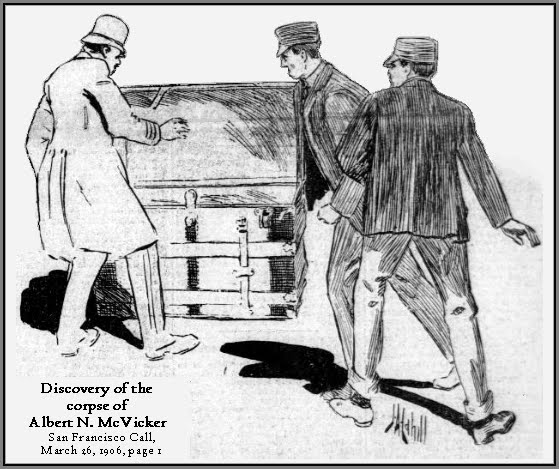
On Mar. 11, 1906 she accidentally came across McVicar, not telling him about her bigamous marriage to LeDoux, and they ended up reconciling. Emma purchased some cyanide and that was the end of him. His bloodied corpse was found at a train station. The trunk was traced to Emma and she was tracked down and arrested. She never admitted guilt and was tried for bigamy and murder. She was found guilty on both counts: a prison term for the lesser count, a death sentence for the greater. She managed, nevertheless, to forestall execution and in 1909 trade a confession for commutation of sentence.

After parole in 1920 she was in and out of prison, having been caught violating parole. It was the illegal selling of the property of her late post-prison husband, no. 5, a Mr. Crackbon, whom she is believed to have murdered, that sent her back to prison for good, where she died in 1941.

[Robert St. Estephe; Based on facts found in: Ellery Queen, “The Body in the Trunk,” The American Weekly, Jan. 20, 1957, p. 10; Jay Robert Nash, The Great Pictorial History of World Crime, Volume 2, 2004; “Bigamy”]

***

Article from 1931:

FULL TEXT: For the third time, Emma Le Doux is in California’s San Quentin Prison, under life sentence.

Although she now is faded and close to 60, men and romance brought about her latter-day downfall just as they did in the days when, as the “trunk murderess,” she was known all over the United States.

Emma LeDoux achieved notariety as the “Stockton trunk slayer” in 1906. She also was the first woman sentenced to hang in California. Also, she was the first woman to be paroled, break the parole agreement, and win yet another chance. Now, she faces the prison walls for the rest of her life.

Men and romance have figured in her life for 30 years. Her great regret, as she returned to prison, was the blasting of her latest romance.

“I’m afraid it ‘s all over now,” she said. “We were to he married next month. He is a Portland contractor, whom I met several months ago.

Romance blossomed early in the life of the woman, born to parents of comfortable circumstances on a California ranch. She was little more than a child when she married. She divorced this husband. Her next husband was Jim Williams. He took out heavy life insurance in his wife’s favor, and died suddenly.

Then she married Albert N. McVicar, miner, Arizona. And it was his death that has given the woman so much prison life.

The LeDoux “trunk murder” was one of the most sensational criminal cases ot 1906, attracting oatioDwide attention.

~ Ships Body in Trunk. ~

A trunk, left at the Stockton, Calif., station for shipment to San Francisco, was left behind, because it was not properly labeled. A baggageman became suspicious and called police. They found the body of a man, dead from poison.

He was identified as Albert N. McVicar, undivorced husband of Mrs. LeDoux, with whom she had been at Stockton several days. Mrs. LeDoux was traced to San Francisco, where she met a man infatuated with her, and was arrested later, hiding in a small town.

At the trial, the prosecution brought out the fact that Mrs. LeDoux left McVicar, and married Eugene LeDoux in 1906 without getting a divorce. She and LeDoux lived on her mother’s ranch.

Early in 1906, she met McVicar. The latter was working in the Mother Lode mining district. Mrs. LeDoux joined him there, apparently reconciled. They ordered furniture in Stockton to be shipped to the mining camp. The furniture shipment was ordered delayed, and soon McVicar quit his mining job to go, he told friends, to his mother-in-law’s ranch as superintendent. In Stockton, they ordered more furniture, this to be shipped to the ranch. A few days later, McVicar’s body was found in the trunk.

The prosecutor contended that Mrs. LeDoux. was fearful of having her bigamous status exposed. They coupled the furniture purchases to support their theory that she sought the furniture for herself and LeDoux, and poisoned McVicar to get him out of the way.

~ Given Parole ~

After conviction and sentence to hang, a new trial was granted by the Supreme Court. Just before this, she entered a plea of guilty, and won life imprisonment.

In 1920, she won parole. But freedom was short-lived. Within a year, she was in trouble again, and back in San Quentin. Five years later she again appealed for parole. She was 52, and wanted to live a life of usefulness. She was given another chance by the parole board.

Little was heard of her until her marriage to L. A. Crackbon, a California rancher. The couple lived quietly until Crackbon’s death in 1929.

Of recent months, parole officials have received disturbing reports. Court records showed her in and out on minor charges, mostly check cases.

Then came word, according to parole officers, that at 68, she still was a lure for gullible men; that through a matrimonial bureau for which she was sole correspondent, she was hearing from scores of lovelorn men with money.

She was arrested in Oakland on a minor charge, and given a suspended sentence. Parole officials began a search for her. And now the woman, who was sentenced to hang and. twice paroled from a penitentiary, faces incarceration the remainder of her life.

Emma has made three requests of the warden, now that she’s back for the rest of her days. She wants her old prison number again. She’d like to have the same cell she occupied so many years. Also, she wants to again be given work as a prison seamstress.

[“California Woman Goes to Prison For Life Term for the Third Time,” Indian Journal (Eufaula, Ok.), Jun. 4, 1931, p. 5]

***

HUSBANDS:
Husband No. 1 – Charles Barret; married ca 1887; died in Mexico (or divorced, as was claimed), ca. 1891.
Husband No. 2 – Jim Williams; married ca. 1896; died ca. 1902.
Husband No. 3 – Albert N. McVicar, divorced; married. Bisbee, Arizona; Sep. 1902
Husband No. 4 – Eugene Ledoux; married Aug. 12, 1905.
Husband No. 5 – L. A. Crackbon, married ca. 1925; 1929.

***

When arrested, Emma said, "I expected it, but I did not think I would be caught until I reached my mother's home in Jackson."

***

CHRONOLOGY:
1871 – Emma Head born.
c. 1887 – marries Charles Barret, (Emma Cole [sic] was 16).
Sep. 1902 – Husband No. 3 – Albert N. McVicar, divorced; married.
Aug. 12, 1905 – Husband No. 4 – Eugene Ledoux, elderly.
Mar. 4, 1906 – E. L. purchases cyanide.
Mar. 15, 1906 – E. L & McVicar arrive in Jamestown.
Mar. 21, 1906 – McVicar quits his long-standing job.
Mar. 24, 1906 – McVicar body found in trunk.
Mar. 26, 1906 – E. L. arrested; Antioch, Ca.
Jul. 4-23 , 1906 – trial; convicted for bigamy & murder, sentenced to death.
Aug. 7, 1906 – sentenced to be hanged.
Arp. 10, 1907 – stay of execution secured.
Oct. 9, 1907 – scheduled date of execution.
Jan. 13, 1908 – case argued in Supreme Court.
May 1909 – Supreme court orders new trial.
1910 – confesses McVicar murder; sentence commuted.
Jul. 20, 1920 – paroled from San Quentin.
Jul. 9, 1921 – back in prison; parole violations.
Mar. 30, 1925 – paroled.
Ca. 1925 – marries L. A. Crackbon; Husband No. 5.
1929 – Crackbon dies.
Ca. 1929 – E. L. back in prison; illegal sale of dead husband’s property.
1931 – About to marry a “Portland contractor” when sent back to prison.
1933 – transfer to Tehachapi Women’s Prison.
Jul. 1941 – E. L. dies.
***

***

***

***

***

***

***

***

***

***

***

***

***

***
 

For links to other cases of woman who murdered 2 or more husbands (or paramours), see Black Widow Serial Killers.

***
[2715-2/3/21]
***