Showing posts with label Fathers' Rights. Show all posts

Sunday, September 2, 2018

Fathers’ Rights in Italy: Protest Against Suicides Resulting From Malicious Child/Father Access Denial


Fathers’ Rights in Italy: Protest Against Suicides Resulting From Malicious Child/Father Access Denial - By Robert St. Estephe

(This article was written in 2009 for the now defunct Glenn Sacks website. It was declined because suicide was considered to reflect badly on father’s rights activism because suicide is “violent.“ At the time the term ‘“toxic masculinity’“ had not yet gained currency as a feminist ideological explanation for male suicide.)

***

Rome – April 7th, 2009 marked the 4th annual ‘“World Memorial Day’“ demonstration, an event held in Rome’s historic Piazza di Spagna. Giorgio Ceccarelli, president of the Italian organization Figli Negati (‘“Children Who Are Denied’“), announcing the memorial in his 2009 press release stated that the annual April demonstration is held in ‘“remembrance of all those Dads in the world who have killed themselves: men who have been destroyed by the pain because contact with their children was blocked by legal separation.’“

The date April 7th was chosen in honor of Antonio Sonatore, an Italian school teacher who set himself fire on April 7, 1996 in front of the Aosta Court House when a judge barred his access to his daughter following his separation from his wife. During the 2009 demonstration a minute of silence was observed at noon to commemorate another Italian father, Daniele De Nicola, who committed suicide on November 15, 2007 following the abduction of his son. Pro-family organizations from all over Europe are represented in the event. [Robert St. Estephe]

***

‘“Separated fathers protest in Rome’“ Italy Magazine (English), Apr. 8, 2008

FULL TEXT: An association representing separated fathers staged a protest Monday near the Spanish Steps to draw attention to the plight of fathers who are denied visitation rights with their children. The demonstration coincided with the 12th anniversary of the suicide of Antonio Sonatore, who took his life outside the Aosta court house after he was denied the right to see his daughter. It is estimated that some 2,000 separated fathers commit suicide in Europe every year because they are not permitted to see their children. Monday’s protest included a number of black coffins to symbolise these deaths.

‘‘We want to remember those who have killed themselves and those who will commit suicide,’’ said Giorgio Ceccarelli, the founder and chairman of the Fathers’ Armada association, which is part of a Europe-wide association of like-minded groups which campaign for the rights of separated fathers.

‘‘In Italy, separated fathers are totally abandoned by the institutions,’’ he added. ‘‘Our country is the only one in Europe which does not have a Fathers’ Home,’’ a support centre for fathers left in emotional and financial difficulty after an acrimonious divorce.

Similar structures exist for women in Italy but not for men.

In the past the Fathers’ Armada has staged colourful demos in support of its aims, including a Batman parade around the Colosseum, marching through central Rome sporting orange wigs and large false breasts, wearing chastity belts at Rome airport and stripping down to boxer shorts to show how child support payments can leave them penniless.

The Fathers’ Armada won an important battle in January 2006 when parliament passed a law which strengthened the access and custody rights of divorced fathers and made joint custody of children the norm when parents split up.

In the past judges gave the mother sole custody of children in around 85% of cases.

‘“Separated fathers protest in Rome’“ Italy Magazine (English), Apr. 8, 2008

***


Daniele de Nicola (died November 15, 2007)

A father of 31 years of Livorno has not endured the pain of losing his child, kidnapped by his mother in the indifference of the authorities to this type of crimes. The father had papered the city of his son’s pictures, the authorities let the child be made to go abroad on a regular scheduled flight.
In November 2007 Daniele hanged himself in the apartment he had just finished renovating for his family, and only grandparents remained to ask for the baby’s return home.


***


APRIL 7, 2013, Aosta, Italy – A yellow flower, yellow as the brooms that pitifully, seventeen years ago, someone leaned on the black spot of gasoline in front of the court, where Antonio Sonatore sprinkled with gasoline and burned himself. It was April 7, 17 years ago; it was Easter morning and the man, psychologist and teacher, protested against a court ruling that allowed him to see his daughter only once a month. Sunday morning, before the court, the Association of Separate Parents for the Protection of Children organized a small ceremony, a bouquet of yellow flowers, a simple writing, 'Antonio Sonatore, a father', a moment of silence and then an applause for that father "guiltily forgotten" according to the association that asks the administrators of Aosta to name a street to Antonio Sonatore and to install a stele in his memory in the gardens before the court.

The service and photos on Gazzetta Matin on newsstands on Monday 8 April. In the photo, yellow flowers to remember Antonio Sonatore. (cinzia timpano)

[“Aosta named a street to Antonio Sonatore, the father who set himself on fire because he could not see his daughter,” newsvda.it, Apr. 8, 2013]

***

***

***

***
[426-4/6/21]
***

Tuesday, December 3, 2013

The Fawcett Testamentary Parental Case - Utah 1927


NOTE: This is but one of many cases of a type what I call “Testamentary Parental Kidnapping,” a type of malicious child/parent access denial related to what is commonly called Parental Alienation.

***

FULL TEXT: Six months ago little 11-year-old Anna Margaret Fawcett, central figure in an unusual child contest case, clung to her maternal grandmother in court and referred her to her maternal grandmother in court and referred to her father as “Mithter Fawcett.” Saturday, after living with her daddy for six months, she clung to him.

It was one of those cases where there must be so much sadness whichever way the judge decides. Judge Chris Matheson has had it in charge.

The little girl’s mother is dead. The mother and father were divorced, she alleging desertion and failure to provide in 1913. The child was given to the mother and the mother in turn lived with her own mother, Mrs. A. Mellick, according to the evidence.

The mother, on her deathbed, asked Mrs. Mellick to keep the girl, according to the evidence. Mrs. Fawcett died in July, 1926.

In a few months Mr. Fawcett laid claim to his child, contending he was entitled to her custody as natural parent. He did so through habeas corpus proceedings and on December 16 the court order that on his filing a bond of $1000 he should have the child to June 15, 1927, and on that date produce her in court for further hearing and final settlement. He has remarried.

The matter was hotly contested at the time. The grandmother claimed the child’s affections, and little Margaret in December turned her eyes toward her eyes toward her and away from the father. It was hard for the court to make the order. He gave the man an opportunity to care for his child, win its love and make good his claim to her.

On June 15 the grandmother failed to appear, and the court ordered permanent custody to the father, but reopened the case when Mrs. Mellick requested it.

Further hearing was had and the court held that the father had proved his right. He upheld the doctrine that the natural parent should have first claim. A grandmother was turned away sorrowing with the comfort only that she may visit the child, who now lives in Los Angeles whenever she chooses, under a part of an order. Mrs. Mellick lives in Salt Lake.

[“Child Prefers ‘Dad’; Court Heeds Choice – John Fawcett Awarded Custody of 11-Year-Old Daughter.” The Salt Lake Tribune (Ut.), Jun. 19, 1927, p. 20]

***

Other Testamentary Parental Kidnapping stories:


***

Monday, November 11, 2013

Parental Child Kidnapping – Already a Common Occurrence by 1856


The following article is noteworthy for offering evidence, in its comment on the case of a Mr. Thompson, “which has all too many parallels in California,” suggesting that parental kidnapping was already, by the 1850s quite a common ocurrance in the United States

***

FULL TEXT (Article 1 of 2): We would call attention to an advertisement in another column, under the caption of “Information Wanted.”  Mr. Thompson has called on us, and told us his story. It is one which has all too many parallels in California, yet he is entitled to heartfelt sympathy. It seems that about five months ago, he sailed for China, leaving his wife and two children in San Francisco. Before leaving he gave his wife $375, with which to pay her passage by the steamer to New York, he expecting to return to China by Cape Horn. The vessel, however, and took passengers to this port. On arriving, Mr. Thompson first learned that his wife had not returned to New York, but was living at Vallejo with a man named John Forman, as his mistress.

Thither Thompson went, but found the parties had come to this city, some two weeks previous. He followed here, learned their arrival about that time, but could obtain no further certain clue to them. Partial information leads him to the belief that they went from here to Sonora. Mr. Thompson merely desires to recover the possession of his two children (girls), respectively six and eight years of age. John Forman, the despoiler of his happiness, is represented as being a ship caulker by trade; is a stout built man, about five feet six inches in height, with red whiskers.
The eldest child, Eliza, is of light complexion, blue eyes and has lost two of the lower front teeth. The youngest is of dark complexion and has a scar on the forehead. Any information of the parties will be thankfully received by Ananias Thompson (who appears to be as highly respectable man) at the Globe Hotel, corner of Davis and Chambers street, San Francisco.

NOTE: The comment “all too many parallels” indicates that parental kidnapping was already recognized as a “social problem” by 1856 in California.

[“A Recreant Wife,” Weekly San Juan Republican (Stockton, Ca.), Jul. 5, 1856, p. 3]

Paragraph breaks not in original

***

FULL TEXT (Article 2 of 2): We published the other day a case of seduction and desertion, the aggravated party being Mr. Ananias Thompson. In the account we published, it was stated that the seducer was a person named John Forman. From the Bay papers it would seem that the recreant parties had separated, Mrs. Thompson, alias Mrs. Forman, having left her last paramour, a married man at San Francisco named Dougherty. Mr. Thompson learned the fact, applied at the police office for a warrant for her arrest for the purpose of recovering possession of his two little girls, but the papers state, [sic] he was informed that he could not testify against his wife, except in a case of assault and battery. He then obtained a friend, cognizant of the facts, to make the complaint, and the warrant was issued.

[“Charge Of Bigamy,” Weekly San Juan Republican (Stockton, Ca.), Jul. 12, 1856, p. 2]

***
[508-4/9/21]
***

Wednesday, August 7, 2013

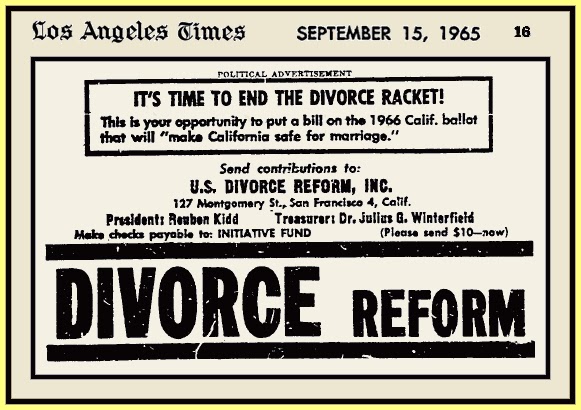
Anti-Misandry in 1961: United States Divorce Reform, Inc.


FULL TEXT (Article 1 of 5): New York – The “Divorce Racket Busters” are after me – and I’m not even divorced.

They’re after every man that’s got a wife and want to warn him of the doom they claim is awaiting him.

They’re trying to free husbands from alimony slavery. Especially in California. Where, they claim, it’s scandalous.

They’ve got headquarters on Citrus Heights, Calif., and Reuben P. Kidd writes that “We need to impress upon all ‘happily married men’ that their freedom is in jeopardy and is entirely dependent upon the whims of their wives.”

They’re circulating a cartoon titled “The Alimony Joy Ride” which shows the ex-wife, her lawyer and the judge celebrating her divorce, with the poor husband pushing the car in which all three having their joy ride.

“Don’t be a pushover,” says the cartoon. They then want to change the California laws.

I’d like to show this to my wife – but I’m afraid to.

[Earl Wilson, “Divorce Racket Haters Calling All Husbands,” syndicated, The Hammond Times (In.), Jul. 31, 1961, p. A-7]

***

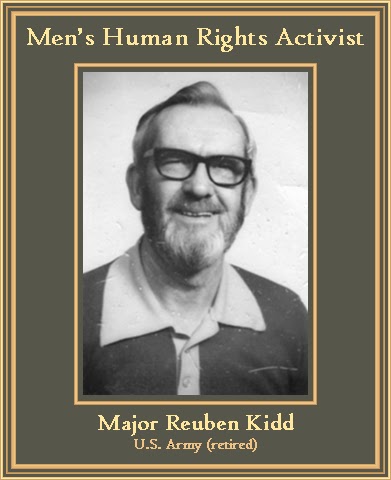
FULL TEXT (Article 2 of 5): Sacramento, Calif.— Former Army Maj. Reuben Kidd who survived four years of military combat and came home to face a divorce action, has opened a nationwide attack on alimony, community property and women's right to custody of the children.

He says he is encouraged by “at least 1,000'” sympathizers in California and “hundreds” elsewhere in the nation, and adds be has begun the initial mailing of membership applications for his new organization.

It is called United States Divorce Reform, Inc. (USDR), and was chartered Nov. 20, 1961, by the California secretary of state.

Kidd contends that divorce laws in many states encourage marital breakups by making them easy, if not downright profitable for women. He is not opposed to divorce, but he favors enforcing “responsibility” on the female partner.

USDR was conceived early last year in a Sacramento attorney's office. There, Kidd learned that his wife's divorce action would enrich her by $22,500, or half his total wealth.

He started modestly with letters to the editors of local newspapers, and said he gradually found supporters in California, Nevada. Michigan, Wisconsin,  New York, New Jersey, Massachusetts and the Panama Canal Zone.

Kidd said most supporters are men like himself who believe themselves victimized, by a divorce settlement, but he said “many, many” women had written to him.

Kidd said that USDR would seek changes in current law with the usual political tools: letter writing, lobbying, financial support for sympathetic candidates. Basically, Kidd wants:

—Community property laws that give each partner the property that he or she brought to the marriage.

—Eventual abolition of alimony.

—Recognition of a father's equal right to custody of the children, based on the father's equal ability to use modern child care services.

[“Organization Asks Divorce Law Reforms,” syndicated (UPI), Oshkosh Daily Northwestern (Wi.), Dec. 30, 1961; same article with different headline: “Major Declares War on Divorce Laws, Battles Alimony, Right to Custody,” syndicated (UPI), Ogden Standard-Examiner (Ut.), Jan. 5, 1961, p. 9]

***


***

***

EXCERPT (Article 3 of 5): Alimony payers are collectors of injustice stories. They seem to derive some black enjoyment from tales of legal maltreatment. Reuben Kidd, for instance, a big dark-haired man with a vague resemblance to Robert Ryan, begins his bitter narrative by mentioning he was awarded a medal for combat heroism for World War II. “I fought for freedom,” he says. “Freedom for almost all Americans, including my wife – but not including me.”

Kidd consulted a lawyer when his childless marriage began to break up. Listen, said the lawyer, “whatever you do, don’t bring the money question to court. California courts will murder you. Negotiate a private settlement with your wife beforehand. Whatever she asks for, take my word, it’ll be less than a court would award her.”

Kidd’s wife asked for, and got, a substantial share of Kidd’s property. What seems to have stabbed Kidd most deeply is the fact that his settlement included some Army pay he had saved during the war, before marriage. “One of the things we were fighting for in that war,” he notes gloomily, “was the right to own property – freedom from legal confiscation.” Reuben Kidd came out of this experience howling mad and promptly organized U.S.D.R.

[Gunther, Max, “The Fraternity of Crippled Men,” The New York Times Magazine, Sep. 19, 1965, p. 34]

***

Here is a report from 1964 on one of the regional offices, in West Virginia.

FULL TEXT (Article 4 of 5): (Charleston, W. Va.) – Mrs. Henry Christy of Camden Drive is fighting for men’s rights “against women who are making a racket out of divorce and lawyers who are getting benefit out of this racket.”

An assistant director of the East Coast Woman’s Division for U. S. Divorce Reform, Inc. Mrs. Christy spends a good deal of time studying the problem of divorced people and writing and speaking on their behalf.

“There is no equal justice for a man at all the way today’s laws are written. Just because the law says the man is in the wrong or the wife says so doesn’t make it so. There are always two sides to every story and one can be  as bad as the other,” Mrs. Christy said.

Of  course, there are times when men aren’t any good at all but laws are ridiculous when they allow a woman to take everything.

“Why should a man pay a penalty for the rest of his life because he has made one mistake? Why should an innocent second family starve because of a grasping ex-wife?

~ RIGHTS AREN’T RIGHT ~

“Why should a man support children he is not allowed to see? Visitation rights aren’t upheld, especially in Kanawah County. A father can’t be a father to a child if he doesn’t see it.” Mrs. Christy continued with fire in his eyes.

Just because a mother is a mother and a woman doesn’t mean she is a good parent and it’s not necessarily right for her to have the children. A father can pay a babysitter just as well as a mother can.

“I don’t say men are always right, but I do say decisions should be made on facts in the case and not because she is a woman and he is a man.

~ NEED FAMILY CENTER ~

Mrs. Christy believes, along with the organization which she represents that “The biggest need in divorce reforms is a family center to which a couple may go when they are faced with the possibility of divorce. The center should have specialists in human relations, psychologists, social workers and clergymen of the couple’s faith. The board would take time to investigate and see if the marriage is workable. Ample time should be taken for consideration. Many demanding divorces are angry and upset and say, ‘I’ll just get a divorce! Rather than say ‘Let’s try to work things out.’”

Mrs. Christy is the daughter of the late H. B. Sheets, a city fireman for 23 years. She likes mixing with people and reading books about children and child psychology.

Her husband works for DuPont’s Belle plant and loves to fly planes. She met him when he asked her son, Roy, if he would like  to take a plane ride. Roy and their own son, Scottie, share Dad’s enthusiasm about flight. Mother’s an earthling.

When Mrs. Christy ran for the legislature, Mrs. Christy campaigned right along with him. “We lost this time but we’ll try again,” she said.

Mrs. Christy has been active in the fight for divorce reform for about three years and a director since the women’s division was organized in January, 1964.

She answers mail from people with problems from at least 13 states, Pakistan and Canada.

“Not all people who have joined the fight have divorce problems,” she said. “Many who work with us are happily married and interested in preserving the American home.”

[Wilma Higginbotham, “Divorce Law Reform Sought To Provide Justice For Husband,” Charleston Daily Mail (W. Va.), Jul. 7, 1964, p. 9]

***

FULL TEXT (Article 5 of 5): San Francisco – Divorce American style, described by its opponents as “trial by combat” and “lawyers’ blackmail,” would go out the window under a proposed amendment to the California State Constitution.

Court actions with their personal battles, high law fees and headline publicity would be replaced by decisions of a state department of family relations run by six elected directors.

Backers of the proposal announced Thursday a drive to get the required 468,259 signatures by April 12 to qualify for a June 7 ballot.

The amendment is sponsored by United States Divorce Reform, inc., an organization with chapters in 43 states, Australia, Germany and West Pakistan. Many of its leaders are losers in state divorce courts.

G. J. Winterfield, 50, California director of the reform group, told a news conference that California was chosen as the pilot state because “it leads the civilized world in divorce.”

“We have got to stop this slaughter of our homes if we are to survive as a nation,” said Winterfield, a doctor of chiropractic medicine and divorced father of four children.”

“We are destroying homes to get rid of relatively minor problems.”

Under the proposed amendment the Department of Family Relations would have exclusive jurisdiction, subject to appellate court review, over divorce, annulment and separate maintenance proceedings.

[“Ending Of American Style Divorce Urged,” syndicated (UPI), The Daily News (Huntington, Pa.), Jan. 28, 1966, p. 1]

***

For a detailed history of Reuben Kidd’s history, see: Dads America, “Founding Fathers”

***


***

***

For more revelations of this suppressed history, see The Alimony Racket: Checklist of Posts

***
[1338-4/20/21]
***

Friday, September 14, 2012

Military Mom Kidnaps Son, Denies Father Access to Child, Boyfiend Kills Child, Military Doesn’t Even Inform Military Dad - 2008


FULL TEXT (Article 1 of 2): Uruma, Okinawa — It’s been a year since 8-year-old Jordan Peterson died from injuries allegedly inflicted in a beating by his stepfather at his off-base home in Uruma.

But it was just last week that Jordan’s real dad found out his son was gone.

“You can’t believe my shock,” Damion Peterson said Monday in a telephone interview from his San Antonio home. “All in one day a friend said he had information that the military on Okinawa had investigated the possibility that Jordan was abused. And then I called my ex-mother-in-law to find out about the abuse and she tells me he’s been dead for a year.”

That was April 7. A Google search of his son’s name then brought home the horrible truth.

Peterson’s sister found a series of stories in Stars and Stripes that detailed Jordan’s death and the arrest — and later release — of the boy’s stepfather, Roberto Deleon, by Japanese police who alleged the child was beaten to death.

“My brother was devastated,” Marlo Saenz said. “The divorce was horrible, but he had always hoped to see Jordan again. He was the sweetest little boy.”

Peterson, 32-year-old former airman now living in Texas, said he had been estranged from his ex-wife for four years and she refused to let him have contact with his son during most of that time. He said she left him while they were living in Germany and he lost the ability to have Jordan for the summer visitations spelled out in their divorce decree.

“I was single, living in the dorms,” Peterson said. “I couldn’t keep him with me.”

He said he continued to have child support taken out of his paycheck, but had infrequent phone contact.

“She’d tell me Jordan did not want to talk to me,” he said.

When Peterson transferred back to the States and was discharged, he remarried. He now has a son and a daughter, ages 2 and 1, and was hoping to work out visitation with Jordan when his ex-wife, Staff Sgt. Sabrina Deleon, returned from a three-year tour on Okinawa that began in 2004.

Peterson said the last time he saw his son was just before the boy’s mother left for Okinawa.

In the week that followed the discovery of his son’s death, Peterson and other family members have been busy seeking information about what had happened. He said he called his ex-wife in Maryland — she is now assigned to Dover Air Force Base in Delaware — but the calls turned into arguments and her phone has since been switched to an unlisted number.

Stripes was unable to contact Sabrina Deleon.

Peterson also said he spoke to Roberto Deleon before the number was changed, but he wasn’t sure who he was at first. Peterson had not known that his ex-wife, who had remarried a man named Brown after their divorce, had gotten another divorce and had remarried on Okinawa.

“He yelled and cussed me out,” Peterson said of Roberto Deleon, 26.

~ ‘Through the cracks’ ~

Peterson said a friend who worked on child welfare cases at a base in Texas told him April 7 that he had seen files from the Air Force on Okinawa that showed “multiple abuse and neglect cases filed against [his ex-wife and Roberto Deleon] by the Family Advocacy Clinic on Okinawa.”

“But somehow the military allowed my son to fall through the cracks because they lived off base,” Peterson said.

Citing privacy rules, the Air Force and Department of Defense Dependents Schools officials have repeatedly declined to comment on whether any reports of abuse were made to them prior to Jordan’s death.

One abuse complaint was filed with Japanese authorities in November 2006, when an Okinawan woman found Jordan wandering barefoot and shirtless, dressed only in shorts, a few blocks from his Uruma home. She said the boy was bruised and told her he was running away from home. She took him to a store and bought him some clothes, but he refused to wear them, telling her that his stepfather would not allow him to wear anything new.

The woman, Hisa Uechi, now 23, called the Okinawa prefectural police, who questioned the boy. But he refused to speak and Jordan was handed over to his mother.

 “It seemed neither the Okinawa or military authorities would do anything for him,” Uechi said at the time.

A year later, Jordan’s death still affects her. On April 11, she left flowers outside the house where the boy once lived. Observing the first anniversary of a death is an important Buddhist-influenced Japanese tradition.

“I just wanted to let him know that he is still remembered,” she said.

~ A new family occupies the house. ~

“There was no trace at all that Jordan once lived there,” Uechi said. “It was like his existence was completely and quietly wiped away.”

She said she shed tears of joy when she learned that Jordan’s biological father and his family are seeking justice for the young boy.

After Jordan’s death, the director of the Okinawa Prefectural Department of Health and Welfare admitted her office failed to properly investigate the November 2006 abuse report.

“We should have gone to his home and checked up on him,” the director told Japanese reporters last July. “It might have saved his life.”

Damion Peterson is working to ensure the case does not fall through the cracks again. He has contacted his congressman to look into the matter and has confirmed with the U.S. District Attorney’s office for the Eastern District of Maryland that Jordan’s death is being investigated.

~ Roberto Deleon remains the prime suspect. ~

Deleon was alone with the boy April 11, 2007, when he called his wife and said Jordan had stopped breathing. His wife rushed home with a military ambulance in tow and the child was taken to the U.S. Naval Hospital on Camp Lester, where he was pronounced dead about two hours later.

An autopsy showed he had a massive loss of blood from internal injuries, according to Okinawa police, who arrested Deleon on May 16 on suspicion of causing the injuries that resulted in the boy’s death.

But on June 6, Deleon was released with no charges filed. Hirokazu Urata, the deputy chief prosecutor for Okinawa, said there was not enough evidence to prove Deleon was responsible.

“The autopsy showed he died from the shock of excessive bleeding caused by recent damage to the liver,” Urata said when Deleon was released. “A criminal act was highly probable, but there is insufficient evidence the suspect inflicted the fatal injury.”
The military had no jurisdiction over Deleon, a civilian, and Air Force investigators forwarded their case files to the U.S. Justice Department.

The Military Extraterritorial Jurisdiction Act, passed in 2000, treats as a federal crime any acts committed outside the United States that would have been considered felonies if committed on federal lands in the U.S. The cases can be tried by any federal court.

In a message to Texas Rep. Nick Lampson, Peterson said the autopsy performed at USNH showed Jordan had a lacerated liver “and ruled the case a homicide with the stepfather as the only suspect.”

“I was not even notified of the murder,” Peterson wrote to Lampson. “His mother hid it from me for a whole year...

“She changed her address several times over the years; she has retained at least three different last names in the past three years and refused to keep me updated about my son’s whereabouts, as she was ordered to do per our divorce decree.”

“I paid child support for Jordan until he disappeared into Japan,” Peterson said Monday.

“We tried several times to get a current address. We even sought the help of the Veterans Administration, but we couldn’t locate her and she never called us — not even about the funeral. Finally, I just felt I’d have to wait until Jordan was older and could see me on his own and I could apologize for the lost years and tell him how much I loved him.”

Jordan’s obituary in the local newspaper made no mention of his father, who visited his son’s grave on the one-year anniversary of his death.

Peterson went there with several other family members, including his 2-year-old son, Israel.

“I stayed there for two hours,” he said. “Israel looks so much like the engraving of Jordan on the headstone that I broke down. I didn’t want to leave.”

[David Allen, “Former Airman Shocked To Learn His Son Has Been Dead For A Year,” Pacific Stars & Stripes (Okinawa, Japan), Apr. 16, 2008]

***

FULL TEXT (Article 2 of 2): Baltimore, Md. – U.S. District Judge Richard D. Bennett sentenced Roberto E. DeLeon, age 28, of Glen Burnie, Maryland today to 30 years in prison, followed by five years of supervised release, for the murder and assault of his stepson while the family was stationed in Japan. DeLeon was convicted by a federal jury on October 22, 2009.

The sentence was announced by United States Attorney for the District of Maryland Rod J. Rosenstein; Brigadier General Dana Simmons, Commander Air Force Office of Special Investigations; and Special Agent in Charge Richard McFeely of the Federal Bureau of Investigation.

"Robert DeLeon has been held accountable for the senseless murder of his 8-year-old stepson Jordan Peterson in Japan, where Jordan's mother was serving in the U.S. Air Force," said U.S. Attorney Rod J. Rosenstein." Although the murder did not occur on a U.S. military base, federal law allows us to prosecute persons who accompany our Armed Forces for crimes committed in foreign countries."

According to the evidence presented at the three week trial, Jordan died on April 11, 2007, as a result of internal bleeding due to a laceration of his liver caused by blunt force trauma to the abdomen. The injury is consistent with a hard punch to the stomach—a type of punishment and discipline DeLeon would inflict upon Jordan, according to trial evidence. Jordan was 8 years old, 3 feet 11 inches, and weighed 52 pounds at the time of his death.

At the time of Jordan's murder, DeLeon was the husband of a member of the U.S. Air Force assigned to Kadena Air Base in Japan. DeLeon had joined her and her two children on a tour of duty. The evidence at trial showed that, very soon after DeLeon moved into the family home, he began to assert disciplinary authority over the children. Jordan, in particular, received the brunt of DeLeon's strict and stern measures.

Evidence of the abuse of Jordan, going back to September 2006, came from testimony provided during the trial by physicians, family advocacy personnel, teachers, and neighbors, who had contact with and observed the injuries to Jordan. At the time of Jordan's death, DeLeon was in counselling with the Family Advocacy Program on base because of the severe punishment he inflicted upon Jordan.

According to evidence presented at trial, after the defendant returned to Japan from a brief visit to the United States in March 2007, DeLeon began a new form of abuse: making the young boy stand with his arms outstretched while DeLeon punched him in the stomach as hard as he could.

Evidence established that the fatal blow to Jordan's abdomen was likely inflicted upon Jordan sometime between the night before and the morning of his death. Later that morning, Jordan complained to his stepfather that his stomach, abdomen, and groin hurt; of blurry vision; dizziness; and an inability to eat. At one point, Jordan was slumped over the sink. Emergency medical personnel arrived at about 12:56 p.m. to find Jordan with no vital signs. Despite the efforts of medical personnel to revive the young boy, doctors pronounced him dead at about 2:00 p.m.

The medical examiner performed the autopsy and testified at trial. The autopsy revealed that in addition to the lacerated liver, there were numerous other injuries to Jordan's body including: deep bruises on the buttocks in caused by a belt or strap, bruising on his thigh, multiple bruises to the chest consistent with forceful finger poking, and bruising on the wrist and forearm, consistent with being grabbed. The bruises on the buttocks inflicted a few days prior were the basis of the assault charge in the indictment.

United States Attorney Rod J. Rosenstein commended Assistant United States Attorneys P. Michael Cunningham and Paul E. Budlow, who prosecuted the case.

[“Husband of U.S. Airman Sentenced to 30 Years in Prison for the Murder of His Stepson in Japan, Law Enacted in 2000 Authorizes Prosecution for Overseas Crimes,” United States Attorney's Office, District of Maryland, Press Release, Jan. 6, 2010]

***

Thursday, August 23, 2012

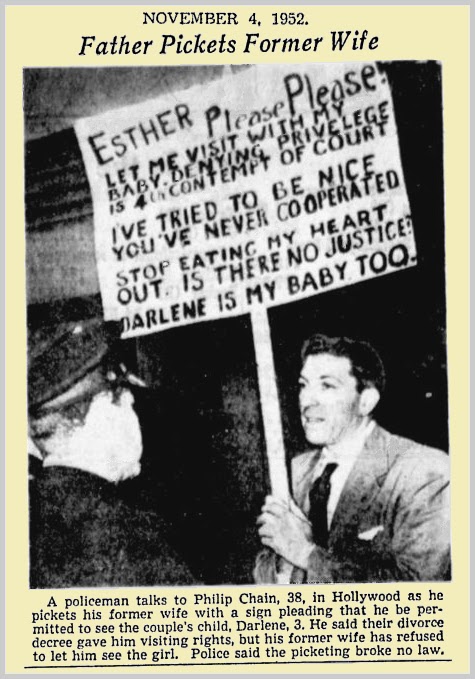
Philip Chain Pickets for Father’s Rights in 1952


Philip Chain is the earliest known example of a father who used picketing to attract attention to his plight as a parent who had been denied access to his child by a malicious mother. It was not until the 1970s that fathers’ rights groups were formed and started doing group pickets, usually in front of courthouses. Chain, however, took his signs to his own home which he was legally barred from. Gender ideologues have for decades claimed fathers only try to “see” their children (as if “seeing” were enough) in order to manipulate the “intrinsic victim of patriarchy,” the mother. The true history of child custody proves otherwise. Despite the fashionable social constructivist theories that are dogmatically spewed and sold by professors, claiming that the further back in history we go the less parents (of both sexes) loved their children, history is on the contrary rich with tales of fathers who made great sacrifices to try to retrieve children that ex’s, the courts and other entities.  A particularly poignant example is that of John McCray.

***

PHOTO CAPTION (Article 1 of 4):

PLEADS TO SEE CHILD – Policeman talks with Philip Chain, 38, who is picketing his former wife in Hollywood, Cal., with a sign pleading he be permitted to see the couple’s child, Darlene, 3.  He told police their divorce decree gave him visiting rights, but the former wife, Esther, refused to let him see Darlene, saying the girl is sick. Police said the picketing broke no law.

[“Pleads To See Child,” syndicated (AP), The Chillicothe Constitution-Tribune (Mo.), Nov. 5, 1952, p. 5]

***

FULL TEXT (Article 2 of 4): “Esther please let me see my baby.”

Carrying a placard on which these words were printed, Philip Chain, 38, of 3200 San Fernando Blvd., Burbank, yesterday walked back and forth in the 800 block of N. Edinburgh St. His wife lives in the neighborhood.

Chain alleged that his former wife, Esther, 30 refused to allow him to see the couple’s baby Darlene, 3, telling him the youngster was ill.

Chain said that he and his wife were married on June 20, 1948, separated last January and that she had obtained an interlocutory decree in September. He said that he was granted weekly visiting privileges by the court.

Mrs. Chain could not be reached for a statement.

Police called to the scene tried to discourage Chain from his picketing but he refused. Officers allowed him to continue, saying he was breaking no law.

[“Man pickets in Plea to See Child,” Los Angeles Times (CA.), Nov. 3, 1952, part 2, p. 1]

***

PHOTO CAPTION (Article 3 of 4):

PICKETS FOR PATER RIGHTS — For the second time since being divorced in 1952, Philip Chain, 38, above, picketed the Los Angeles home of his former wife, Mrs. Esther Critichfield Chain, because she was not at home when he came to visit their 4-year-old daughter, Darlene. According to a court order, Mr. Chain explains, he can visit the child on Sundays and holidays, but this Sunday when he arrived there was a sign on the door reading “Not at home,” so he put up the placards and started picketing the house.

[“Pickets For Pater Rights,” syndicated (NEA), The Sandusky Register-News (Oh.), Dec. 23, 1953, p. 7]

***

FULL TEXT (Article 4 of 4): Philip Chain, 38, who charges that his ex-wife will not permit him to see their daughter, Darlene, 4, was back “picketing” yesterday in front of 853 N. Edinburgh Ave.

He said he came to the house to take the youngster out to dinner but was greeted by a “Not at Home” sign on the front door. His former wife, Esther, 31, had taken the child away to a party, he learned.

Her refusal to allow the child to visit her father from 1 to 6 p. m. on Sundays and holidays is a violation of the court order, Chain said, which granted Mrs. Chain said, an interlocutory degree in September, 1952, and granted him visiting privileges. [sic: a privilege, not a right!]

~ Fifth Refusal ~ 

“This is the fifth time she has refused to let me see my daughter,” Chain said. “The last time I saw her she said unless I paid $13 a week support for the girl I couldn’t see Darlene.”

He explained that he is out of work now and has not been able to pay that amount. He lives with his parents at 2426-A N. Buena Vista St., Burbank.

Legends on the signs he exhibited and some which he taped to window screens of the Edinburgh house read:

“Waiting to see my baby”; “Why can’t a father see his child?” and “I plead for justice.”

The Chains were married on June 20, 1948, and were separated in January, 1952. He said their divorce was not yet final.

[“Man Pickets Ex-Wife; Wants to See Daughter – ‘I Plead for Justice,’ Reads One Legend as Husband Resumes His Sidewalk Parade,” Los Angeles Time (Ca.), Dec. 21, 1953, part 3, p. 4]

***

***

***

***

Monday, August 20, 2012

Samuel Reid: The First Fathers’ Rights Activist? - 1925


Reid was jailed on July 27, 1925. Following is the earliest report on the Reid case so far discovered.

FULL TEXT (Article 1 of 13): Willows, Sept 22. – Although he has been in jail for two months for refusing to pay alimony to his former wife, Samuel W. Reid, still insists he will spend the rest of his life in the bastile before he will carry out the court order.

[Untitled, Hayward Semi-Weekly Review (Ca.), Sep. 25, 1925, p. 7]


FULL TEXT (Article 2 of 13):

~ All for a Principle ~

Sacramento, Cal. – Entering the third year of his “alimony martyrdom,” [jailed on July 27, 1925] Sam W. Reid, wealthy Glen County rancher, denied he was enjoying his lone, self-imposed imprisonment for refusal to pay alimony to his divorced wile. “I have spent three years in jail on behalf of a principle,” Reid muttered through the bars I am willing to pay $90 a month for upkeep of my daughter, but I’ll not pay one cent to support my former wife and her husband if I have to stay in jail the rest of my life.”

[“How the Other Half Lives” (Column), “All for a Principle,” The Charleston Gazette (W. Va.), Jul. 17, 1927, p. 2]

***

Reid’s case inspired the following correspondence in the Elsie Marlow advice column:
FULL TEXT (Article 3 of 13):

HAS A FATHER A RIGHT TO HIS CHILDREN?

Does that seem to be a silly question to you?

Then you should listen in while some of the Divorced Papas of this nation broadcast their grievances.

According to them a father stands just about as much chance in the divorce courts of our various States as a rabbit in the well known tropic regions.

Here's E. C., for example.

DEAR ELSIE:

Much has been written about the case of Samuel Reid, the Alimony Martyr of California. Reid is being held a prisoner in one of the jails of that State because of has refusal to pay alimony to his divorced wife while he is deprived of any voice in the shaping of his daughter's future.

Reid and his wife were divorced. The custody of the child was awarded to the mother, Reid  was refused the right to say where or how his daughter was to be reared. He refused to pay the alimony under such conditions and has been in jail ever since, about two years.

I believe the public is pretty much in sympathy with the prisoner and that the judge’s attitude in this matter is open to criticism.

About eleven years as I was faced with the same problem in one of our larger cities. My wife sued me for divorce and pending the trial of the case the judge ordered me to pay alimony and turn the two young children over to their mother.

I protested against the associates of the mother and against the environment into which the children would be thrown if given into their mother keeping. The judge stated that he would give them to the mother and that if she persisted in keeping them in objectionable surroundings, he would take them away from her and put them in a convent.

There was nothing in the divorce charge that reflected on my character. I loved my children and was simply able to provide for them. But according to the judge’s ruling, I was not to be considered at all in any disposition made of the children except in the footing of the bills.

I refused to accept such a ruling and removed my children beyond the jurisdiction of that court, in fact, out of the State. I was than haled before the judge on the grounds of kidnaping and threatened with jail, but the judge did not have the nerve to carry out his threat. Was I right or wrong?

I think the attitude of Mr. Reid’s wife smacks of vengeance and persecution and thus the judge should admit an error has been made and give the prisoner his freedom.
E. C.

There’s the opening wedge for a big argument. Many take the attitude that Mama Can Do No Wrong, But Papa Can Do Nothing But.

Should the Mother always receive greater consideration in our courts? Do you believe that Mother Love is ALWAYS greater than Father Love?

How about the Mama who sets the little darlings to spy on Papa, when they go see him once a month?

How about the divorced Papas and Mamas who carry on a guerilla warfare, using their children as a medium of exchange?

Don’t he partial – let’s have both sides of the story. If you think that Mamas are getting the worst of it, say so right out loud. Or, if you’re for the Papas, give your reasons.

[Elsie Marlowe, “Where Divorced Men Stand With Their Children” ‘Alimony Martyr of California’ Comes Forward Again,” (Premier syndicate), Athens Messenger (Oh.), Apr. 22, 1927, p. 9]


***

FULL TEXT (Article 4 of 13): Willows, Cal., Aug. 24. – Sam Reid, star boarder at the Glenn county jail, and world’s champion “alimony martyr,” and a red-haired young man who has had quite a disturbing influence on politics hereabout, is at it again.

Not content with costing county officials several thousand votes and many sleepless nights, Reid has determined to reopen his crusade for “freedom with out concession” by appeal to Governor Young.

Linking with his clemency plea a request that the state made a thorough investigation into the reasons for his martyrdom, the 32-year-old apostle of “equal rights tor men” will petition the governor for a full pardon.

“Someone is acting loony in this case, and I’m not the man,” Reid told International News Service today. “A jury of alienists has adjudged me perfectly sane. I can and I won’t pay. I can be free and I won’t be free. What’s the reason? Surely it is time the state makes an investigation before my board bill amounts to the size of the war debt.”

Reid, now entered on the third year of his self imposed imprisonment, is adamant in his resolution not to contribute to the support of his child while she is left in the custody of his former wife, who has re-married. He also stands pat on his original challenge of “Not one cent for alimony.” But that feature of the celebrated case has been solved by his ex-wife’s remarriage.


In his letter to Gov. Young the “alimony martyr” declared he will present a complete review of the famous case, which began in February. 1925, which Reid was ordered by Superior Judge Claude F. Purkitt to pay his former wife for the maintenance of their child, and refused. He will submit his record as a soldier overseas and his record at home as a prosperous farmer. He will present evidence which he claims proves his contention that his former wife should not be entrusted with the cure of their daughter.
 
As further evidence of his good faith, Reid Declared he Mill agree to pay more than four times the amount for the support of little Zada May Reid required by the court. But he “will pay it only on the condition that my daughter is placed in a good Christian home.” Mrs. Anna L. Saylor, newly appointed chief of the State Department of Social Welfare, will be asked to investigate the case.

Reid today is the biggest political issue in Glenn county, according to his friends here. One County official went down to defeat at the polls recently as a result of his imprisonment, they say, and Judge Plunkett is declared to be facing almost certain defeat at next year’s election unless “the white elephant in the county jail” is released.

While county officials argue the matter and seek vainly for a solution, Reid is working for the overthrow of “unjust alimony laws.” He has joined the Alimony Payers’ Protective Association [founded after the beginning of Reid’s campaign], a national organization composed of those who believe that “It is the man who pays and pays,” and is working through that association to break down the present system.

[Clem Whitaker, “World’s Champion Alimony Martyr Is Asking Freedom,” syndicated (INS), The Victoria Advocate (Tx.), Aug. 24, 1927, p. 4]


FULL TEXT (Article 5 of 13): If Samuel W. Reid, of California, goes down in history at all, it will be as the first champion of Equal Rights for Men. In the social Roll of Martyrs he will be emblazoned as the first “Alimony Martyr.”
           
What thousands of men have wanted to do, what hundreds have threatened to do, Reid has done. His strike against what he terms “the viciousness of the American alimony hysteria” is comparable to famous hunger strikes. He is in jail for his principles along these lines. He will die in jail, he swears, before he will deviate one inch from his stand.

“Millions for defense, but one not one cent for the tribute of alimony” is his clarion slogan, and the thousands of alimony payers throughout the United States, who meekly pay what Reid calls “legalized blackmail,” echo those noble sentiments without, however, joining Reid in his jail strike.

It began back in July 1925, when Reid was cited for contempt of court. The preceding February his wife had been granted a divorce.

Alimony had been fixed by justice C. F. Purkitt of Willows, California – a respected jurist who had formerly been chairman of the Democratic State Central Committee. Reid had failed to meet the alimony payments. Judge Purkitt ordered him sent to jail until he decided to pay up.

No one in California paid any attention to what appeared to be a routine divorce alimony tangle. No one thought, in July 1925, that young Samuel W. Reid was to become increasingly famous as “The Alimony Martyr,” that county officials and the very judge who committed him would be anxiously awaiting seeking means of getting rid of him, that two Governors of the State would be appealed to in his strange case – or that as he persisted in his lone stand even when attempts were made to prove him insane, this young unknown would receive such a flood of encouraging letters from all over the nation – and many of them from women – bidding him keep up courage and continue his one-man filibuster on behalf of altering the prevailing alimony system.

Reid was in jail six months before people generally knew he existed. In Willows, he had been a spruce, quick-witted figure. His face smooth and unlined, his garb clean and his hair well-trimmed. A prosperous young farmer of 30 years; a war veteran of the 353rd Infantry, with service in the Argonne and St. Mihiel to his credit.

When finally, he attracted more than local interest, he was looking through the bars of county jail, a bit woe-begone, everything about him changed but his mind. Hair and beard he had permitted to grow, until he had begun to take on something of a resemblance to Anton Lang, of Oberramergau’s famous Passion Play.

The court has ordered: “Stay in jail till you agree to pay alimony.”

Reid had replied: “I refuse to pay while my child remains in surroundings and environment I consider unfit for her upbringing. Change that environment. Otherwise, I shall never pay even though I remain in jail the rest of my life.”

The court meant to be obeyed. In six months, Reid had acquired a beard of a foot long – but no matter what had changed in Willows, Reid’s quiet determination continued. He proved no publicity seeker. He refused even to be photographed. He had taken a stand, and proposed to see it through.

Interest centered upon the ex-wife in this strange impasse. It was found that, in 1917, Phoebe Brownell was a schoolgirl in Orland, California. She eloped with Walter Steuben, who was employed Brownell ranch and, after living with him for nearly four years, sued him for divorce on grounds of non-support. Grieving over the suit, Stephen went to the country home near Orland, owned by J. L. Brownells, parents of his wife, and attempted suicide by shooting himself through the body. He was cared for by the Brownell family and recovered, but nevertheless the young bride obtained her divorce.

 Three years later, she was married to Reid at a fashionable wedding in the St. Francis Hotel in San Francisco. They separated after a year of married life and the birth of Zada May Reid. Each sued for divorce. The wife won the decree on grounds of extreme cruelty, claiming her husband was nagging and fault-finding. Included in the decree was the order to pay for the support of the child. Reid openly admitted he possessed money to meet such payments, but deemed the custodians of the child unfit.

For this – he was in jail. And his ex-wife, who preserved silence regarding him, proceeded to marry her first husband, Walter Steuben.

After a year and four months behind bars, Reid has grown contemptuous of the law’s efforts to break his resolve. He seemed to have sentenced himself to life imprisonment. At 32, he had the hirsute adornment of a hermit And the pallor of a convict. But his Spartanlike disdain for punishment remained undiminished. Though a word from him would have won instant release, he had vowed never to speak that word.

This one-time prosperous young farmer viewed himself as a martyr to a new cause. Down through the ages, as he saw it, men had suffered imprisonment and death for liberty of thought, freedom of religious and other great principles. Reid’s cause had become “freedom from alimony payment” – if he could not have a voice in deciding who should take the child.

From July 27, 1925, when he first went to jail; he felt this martyrdom growing on him. His wife’s remarriage, and the knowledge that his child was now living with that former spouse and her former husband, had only strengthened his resolve and heightened his contempt, until, according to his jailers, his conception of freedom had become a womanless Utopia – a place where alimony was an unknown problem.

“I shall never pay,” Reid announced at this time. “It’s not the money; it’s the principle. What if I am here for life? I’m the first martyr to a great cause.”

But Glenn County officials had officially grown tired of paying the board and lodging bill of this increasingly famous “alimony martyr.”  They proceeded to force a grand jury investigation, in the hope that they might well be rid of this white elephant. Judge Purkitt, who had sentenced Reid for contempt, asked such an inquiry under legal provisions requiring that body to look into the condition of prisoners.

“Reid is defying constituted authority,” Judge Purkitt said, “but there is no excuse for him to remain in jail longer.”

Judge Purkitt recommended that Reid purge himself of contempt by paying the alimony and then apply for modification of the terms of divorce, since the wife had remarried.


To which Reid replied: “I have the money and I can pay, but I still refuse to do so. My case alone is not at stake. The whole alimony system is wrong and I propose to do what I can to right it.”

During his incarceration, Reid has spent a great deal of his time studying up on the unique subject of alimony, and has announced his intention of writing a book on the matter some day.

Alimony is defined as the “allowance for maintenance to which a wife is entitled out of her husband’s estate on a decree for judicial separation or for the dissolution of the marriage.” Though, as a rule, payable to the wife, it may, if the circumstances of the case warrant be payable to the husband. Such cases, however, are admittedly so rare that they would be regarded as worth particular comment when they occur.

Of late years the generous allotment of alimony by American judges has created a situation which does not exist in any other country in the world. The charge is made by certain victims of the alimony laws that there is a class of women who marry with the sole intention of getting alimony, and there are said to be some women who, under various names, have been drawing alimony from several husbands. Alimony was a subject for good-natured jest in the days when divorces were infrequent, but nowadays, when one out of every seven marriages in the United States is dissolved by divorce, and where there is an even greater proportion of legal separations involving alimony payments, the subject is no longer considered a laughing matter, particularly by the victims.

Reid has received letters from hundreds of alimony paying husbands, most of whom state it to be their opinion that they considered alimony a proper institution where there are children, but an unfair and inequitable tax in the case of childless marriages.

“Blackmail, that’s what it amounts to,” Reid said. “I’m willing to sacrifice my life if need be to draw attention to the plight of victims of an iniquitous industry which has the sanction of the courts.”

And while he stays in jail the letters and telegrams of congratulation and gratitude from other “victims” of the alimony laws continue to pour in, and the great number of divorced men who are paying alimony are hoping that the case may result in an investigation of the present laws on the subject.

[“California’s Embarrassing Problem of the First ‘Alimony Martyr,” The American Weekly, Sunday supplement to The San Antonio Light (Tx.), Dec. 25, 1927]

***

FULL TEXT (article 6 of 13): Willows, Cal., Jan. 18 – Samuel W. Reid is a mild-appearing young man, but he is very stubborn.

Which is why he has been in jail here ever since July 27, 1925.

In addition, Reid probably will continue to stay in jail for some time to come. Yet he could, at any time, get out very easily. If he would agree to pay alimony to his wife who divorced him more than two years ago he would be given his freedom at once.

~ Vows He Won’t Pay ~

He won’t. He vows he will stay in jail for the rest of his life rather than pay his wife one cent.

The other side shows no signs of weakening. Consequently, it begins to look as if Reid’s stubbornness will get a very long endurance test.

Reid is an intelligent-appearing, quiet young ex-soldier, who served under fire with the 91st division in France and who is not at all the kind of man you expect to find in jail.

His troubles began when Mrs. Reid sued for, and won, a divorce. The court awarded her custody of their child, a girl, gave her $20 a month alimony and directed Reid to pay an additional $20 a month for the support of the child.

Reid refused, pointblank, to pay one red cent.

He declared that while he was willing to pay for the support of his daughter, his ex-wife was not a fit person to take care of her. So long as Mrs. Reid kept the girl, he said, he would pay nothing; but if Mrs. Reid would give the girl up he would pay gladly.

Refusing to pay, he was found in contempt of court and ordered to jail until he paid.

~ Refused to Yield ~

County authorities were perplexed. Most alimony prisoners soften after a short confinement and agree to pay anything rather than be held prisoners. But not Reid. He calmly announced that nothing on earth could make him pay.

The county authorities felt that Reid must be mentally unsound. They had alienists examine him. The alienists reported that Reid, though very stubborn, was perfectly sane.

Meanwhile, the former Mrs. Reid re-married, taking as her husband the man to whom she had been married before she married Reid.. This increased Reid’s determination not to pay; also it caused him to appeal to Governor C. C. Young for a pardon. Governor Young refused to review his case, however, holding that it was a matter strictly between Reid and the Glenn county superior court.

Then Reid asked the court to review the alimony order. The court held, however, that this could not be done until Reid had first purged himself of contempt; and the only way he could do that was by paying up – which he would not do. So the status quo remains undisturbed.

Next the county grand jury decided to look into Reid’s charge that his ex-wife should not have custody of the child. It investigated her and her home and she was an eminently satisfactory person to take care of a little girl. Reid remained unconvinced, charging that the foreman of the grand jury was a close friend of Mrs. Reid.

~ Refused to Shave ~

During the first few months of his imprisonment Reid refused to shave or have his hair cut, and for a time he presented a strange and shaggy appearance. He soon tired of that, however, and now keeps as neatly groomed as though he were a rising young bond salesman.

His quarters are not regulation jail quarters. He has a room on the second floor somewhat away from the regular cell block. He has a comfortable bed, a bureau, a number of pictures on the walls and a set of his own books. He eats his meals with the rest of the prisoners, mingles with them occasionally in the “bull pen” and, on the whole, seems not to mind greatly being held a prisoner.

[“He Stays in Jail Two Years Rather Than Pay Wife Alimony – Ex-Husband Vows He’ll Never Give His Former Wife One Cent,” syndicated (NEA Service), Jefferson City Post-Tribune (Mo.), Oct. 11, 1928, p. 3]

***


FULL TEXT (Article 7 of 13): Willows, Cal., Oct. 26.— October 10 years ago saw the 363rd infantry fighting, plodding, dying through the mud, muck and morasses of the Argonne and the Ypres-Lys salient.

And the present October finds the remnants of the 363rd still shoulder to shoulder, winning objectives — with the regimental treasury suffering the casualties.

The regiment’s latest victory is winning the four-year “alimony war,” which has almost divided this county, while the “alimony martyrdom” of Sam W. Reid gained nation-wide prominence, and brought threats of everything from appeals to the governor to storming the legislature.

Reid fought in the 363rd during the World war. After the war, he married. A few years later, his wife sued for divorce here. She was granted a degree, custody of their baby daughter, $20 a month alimony and $20 a month for the child’s support. Reid refused to pay. “As long as the child remains in the keeping of her maternal grandparents, I’ll not pay a cent,” was Sam’s defi [challenge, defiance].

“You'll pay or you'll go to jail until you do pay,” in substance was the ukase of the court. Reid chose to defy this edict.

And he was adjudged in contempt of court by Judge Claude F. Purkitt here, and placed in jail.

That was in July, 1925. Reid defending his position as he saw it “dug in” at the jail, prepared for a long stay. The court, equally determined, stood its ground. The case became widely discussed – and hopelessly deadlocked.

Someone brought an insanity charge against Reid. A sanity trial found him normal.
For more than three years he ate and slept as the guest of Glenn county. There seemed no way of breaking the impasse.

Wartime buddies of Reid decided that a visit by the “alimony martyr” to the tenth annual reunion of the old outfit might take his mind off his domestic troubles and instill in “Alimony Sam” a desire to get back into the world again.

Sheriff Roy Heard, tall and popular, had became friendly with Reid during the years of the latter's voluntarily imprisonment. He, too, felt that a new viewpoint was Sam’s greatest need. And although he knew he laid himself liable to serious charges, Sheriff Heard took the prisoner to San Francisco to the reunion. Sam had a wonderful time, he told Heard as they returned to jail.

Then the Glenn County Bar association formally charged Heard with contempt of court in taking the prisoner from the county. A date was set for the hearing.

The 363rd felt that it was losing ground in its fight to rehabilitate Reid. It’s officers summoned an attorney, and rushed here from San Francisco to assist Heard. For hours, the veterans argued with Reid, attacking, his stubborn fight for a principle, telling of the sheriff's plight through working in Reid’s behalf. They pledged the support of the old outfit in getting Sam started again and in any sort of legal action he might later want to take, for custody of his child.

And just before the sheriff was to appear in the overcrowded courtroom on the contempt charge, attorneys announced that Reid had been purged of the contempt charge through payment of the disputed alimony by the 363rd infantry association.

Heard was declared in contempt of court, arid was fined $250.

The treasury of the 863rd suffered its second setback of the day as it yielded the money to pay the fine of the sheriff who braved arrest to go over the top with the 363rd in breaking an impasse.

And now, “Alimony Sam” and his three years in jail here, are becoming a memory; the sheriff is being hailed as a real hero, and the remnants of the 363rd are proving the truth of its boast that “this gang sticks together.”

[Phil J. Sinnott, “Buddies Go to the Rescue – and ‘Alimony Sam’ is Free at Last,” syndicated (NEA), Miami-News-Record (Fl.), Oct. 25, 1928, p. 4]

 
FULL TEXT (Article 8 of 13): “Alimony Sam” Reid, who spent three years in the county jail at Willows rather than pay back alimony which he felt that he did not owe, breaks into the news again.

This time it is in connection with the now Twentieth Century market which opens to Eastbay shoppers on Saturday.

“Alimony Sam” will manufacture and sell candled popcorn at the new market.

“I was offered $400 it week to go on the vaudeville stage after my release from jail,” Reid explained, “but I did not think that I should capitalize on that. I stayed in jail because I felt that I could not meet the order of the court and still retain my own sense of justice. I decided that I would rather earn my living in a regular way. Reid has several vocations and avocations. He decided to enter the market “game” because he loved children. Popcorn, especially candied popcorn, appeals to the youngsters, Reid said. So he capitalized on his candymaking experience and rented a booth in the new market to cater to the sweet tooth or youngsters of all ages. He will make his home in Oakland.

“I like it in Oakland, and I feel this city has a great future.” he said, “so I decided to stake what I have in this venture. I can’t lose.”

The Twentieth Century market began running an “Alimony Sam Says” feature – quips from the folk hero –  with their newspaper ads in this issue of the Oakland Tribune.

[“Alimony Sam Sells Popcorn at Market,” Oakland Tribune (CA.), Dec. 14, 1928, p. 39]

***

FULL TEXT (Article 9 of 13): Sacramento – Sam Reid, one time “alimony martyr” of Glenn county, Wednesday landed a state highway job because he was a member of the 363rd regiment of the 93rd division.

Shabby, hungry and worn out hunting for a job, Reid appeared ac the office of Colonel Walter Garrison, director of public works, also a former member of the 363rd.

“All we’ve got in the way of work is mighty hard work on a state road camp in Plumas county.” Garrison told Reid.

“That’s fine,” Reid replied. “I haven’t had work for months and I haven’t eaten for several days.”

So the former alimony martyr, who once went to jail at Willows rather than pay alimony, got the job and was sent to the load camp where he will receive $4 a day for three days a week.

[“‘No Alimony’ Martyr Works on State Road,” syndicated (UP), San Mateo Daily Times (Ca.), Jan. 28, 1931, p. 5]

***

FULL TEXT (Article 10 of 13): Orland, April 17 – Zada Reid Stuben, 6, daughter of Sam Reid, Glenn county’s famous “alimony martyr” and central figure in his many legal battles to gain release from jail, died last night at a Woodland hospital, following a two weeks’ illness.

[“Martyr Loses Child,” San Mateo Times (CA.), Apr. 17, 1931, p. 1]

***
FULL TEXT (Article 11 of 13): Orland – The death of their daughter, Zada Reid Steuben, six, reunited Sam Reid, famous “alimony martyr” and his former wife, Mrs. Walter Steuben [Phoebe], here Saturday when Reid arrived from Plumas county to attend the funeral. Reid was at the grave for public funeral services for the child.

[“’Alimony Sam’ Attends Funeral of Daughter,” syndicated (Valley News Alliance), Woodland Democrat (Ca.), Apr. 20, 1931, p. 4]

***
FULL TEXT (Article 12 of 13): Sam Reid, famous one-tile “alimony martyr,” Thursday faced suit brought in Willows by his wife, E. B. (sic) Steuben, of Orland, for $779.80, alleged due for medical expenses and burial of their child, Zada Reid Steuben, who died in Woodland, April 16, according to a Valley News Alliance report.

Mrs. Steuben charges the money was expended at the request of the defendant and that he “failed, refused and neglected to pay the money.”

Reid, when last heard of here, was a surveyor for the State Highway Commission at San Luis Opispo.

At the time of the funeral, he said he had not been allowed access to the Steuben home at Orland to see the child in its coffin, although he attended the services at the graveside.

Three hundred dollars, left by the girl’s grandmother, Mrs. Lois Brownell, and which fell to Reid and his former wife at the time of the child’s death, has been attached as a result of the suit.

[“Sam Reid In Court Again As Divorced Wife Sues,” Woodland Democrtat (Ca.), Jul. 30, 1931, p. 1]

NOTE: Lois may have been the child’s great aunt rather than grandmother. Find-a-grave reports the death of Phoebe’s mother, Laura Z. Brownell, on Oct. 3, 1947, in Orland. Laura Z. Brownell was born in 1873.

***

FULL TEXT (Article 13 of 13): Willows, Cal. May 28 – Sam Reid, Glenn county’s “alimony martyr,” today prepared to fight a law suit which he discovered his former wife had filed against him and on which she would have obtained a default judgment in one more week.

Mrs. Phoebe Steuben of Orland, former wife, sought judgment for $7.50 medical and burial expenses for their daughter, Phebe (sic) Reid.

Reid spent several years in the county jail for refusal to pay his former wife alimony. His case attracted national attention.

[“’Alimony Sam’ Will Sue Ex-Wife Again,” syndicated (UP), Oakland Tribune (Ca.), May 29, 1932, p.4]


Two Related Articles:


***

***

For more revelations of this suppressed history, see The Alimony Racket: Checklist of Posts

***
[2109-2/26/21]
***