Tuesday, September 22, 2015

Female Serial Killers of the Jazz Age: 1920s USA


Perhaps seven of the female serial killer cases appearing in this collection may be found in the most complete lists of female serial killers that have been published in the print media (Creighton, Cunningham, Gifford, Klimek, Sorenson, Southard, Wise). TV has covered Carl and Malinsky on "Deadly Women." You will find that a good number of the cases that have fallen to the memory hole are quite amazing.

[Count: 32]

***

1920 – Anna Tomaskiewicz – Northhampton, Massachusetts, USA

“Mrs. Anna Tomaskiewiez, the strange woman ‘Bluebeard’ of South Hartley, was preparing for her sixth husband when her fifth spouse died. Mike Djurizzko, a boarder, was to be her next husband, according to testimony in the case. Mrs. Tomaskiewiez had already tried to obtain insurance made out in her name for Mike. The Polish insurance agent refused to accept the application and it was this fact that led to the unearthing of her tangled career.”

The press said she she was running a “murder factory.” The prosecutor charged “that the woman caused the death of two husbands, one in Connecticut and one in New York, and that suspicious circumstances attended the deaths of the other two.” The jury found her not guilty by reason of insanity. “Mrs. Tomaskiewicz, was seen to smile when the verdict was given by the jury foreman. Mrs. Tomaskiewicz was committed to the Northampton State Hospital for the Insane for life.”


1921 – Clara Carl – Indianapolis, Indiana, USA

Clara Carl Murdered two husbands and a father-in-law. Convicted in 1922 and sentenced to life in prison, she escaped in 1925, but was finally captured and returned. Newspaper headlines reporting her escape described her as the “most daring of women criminals.”


1921 – Erminia (Big Emma) Colavito – Cleveland, Ohio, USA


1921 – Mary Demmer – Schiller Park, Illinois, USA

“Mrs. Elizabeth Harwood, of Bensonville, mother of Mrs. Kolze, told the Coroner, it is said, that Mrs. Demmer had intimated, after her daughter’s death, that ‘something was wrong.’ Shortly before Kolze died Mrs. Demmer is alleged to have told Mrs. Harwood that ‘he would not live long unless he mended his ways.’” Mrs. Mary Demmer was held for questioning in connection of three arsenic deaths was released from custody after two weeks in jail. The state had no evidence against her even though arsenic had been found in the exhumed bodies of Mrs. Demmer’s husband and Mrs. Fred Kolze. The two families made their homes together.


1921 – Dessie Keyes – Elm Mott, Texas, USA

Accused of murdering, with her paramour accomplice, her husband, his wife and his baby daughter the man was convicted, but she went free, despite the fact that the both had made signed confessions. 


1921 – Lyda Trueblood Southard – Twin Falls, Idaho, USA

Between 1915 and 1920 Lyda Trueblood Southard committed, it is suspected, a total of six murders (4 husbands, a brother-in-law, and her own child). In each case she pretended that the deceased had contracted either typhoid, influenza or had died of ptomaine poisoning. In reality they all died from arsenic poisoning,. On November 4, 1921, in Twin Falls, Idaho, Lyda was convicted of the murder of her fourth husband on and was sentenced to 10 years in prison (Boise, Idaho). On May 4, 1931, she escaped and was not captured until July 31, 1932 and by then she had tied the knot with husband No. 5; later they divorced. Lyda was pardoned in 1942 and quickly married again. She died Feb. 5, 1948. It is not known what became of her 1942 catch.


1922 – Edith Murray “The Cleveland Black Widow” – Cleveland, Ohio, USA

Edith Murray’s name was never released to the public although the details of the investigation of her alleged crimes were front page news. The Cleveland Enquirer wrote that: “A divorced husband of a Cleveland woman suspected of having poisoned three of her husbands told Red Cross investigators in Pittsburgh he thought the woman had a mania for collecting insurance. The woman, who has been married five times, divorced twice, and three of whose husbands died suddenly under mysterious circumstances, while two of her children died of poison, told Prosecutor Edward C. Stanton she intended last week to become a bride for the sixth time.” The case was never prosecuted. It was only many decades later that a historian managed to turn up the name of the suspect.


1922 – Tillie Klimek – Chicago, Illinois, USA

Ottilie “Tillie” Klimek (or Tillie Gburek), a Polish immigrant to Chicago, was a serial killer whose suspected victims numbered, in some estimates, twenty, all of whom were relatives or lovers, including three husbands. She pretended to have precognitive dreams, accurately predicting the dates of death of her victims. The crime for which she was eventually tried was the murder of Frank Kupczyk, her third husband. In June 1923 she was sentenced to life in prison, the harshest sentence that had ever been leveled against a woman in Cook County. Her fourth husband, whom she was in the process of slow-poisoning at the time of her arrest, survived.


1922 – Nellie Sturmer Koulik – Chicago, Illinois, USA

Tillie Klimek’s cousin and accomplice, Nellie Sturmer Koulik, was never prosecuted, although the list of her probable victims was very impressive. : 1 – Wojcik Stermer, Nellie’s first husband, died in 1918. Body, exhumed, disclosed arsenic. 2 and 3 – Sophie and Benjamin Stermer, Nellie’s 7-month-old twins, who died within a month of each other in 1917. 4 –  Dorothy Spera, 2 year old granddaughter, who died in 1921, after her grandmother insisted that she be brought to her home for a simple cold. 5 – John Stermer, 22, Nellie’s son, who became ill in 1918 when his father died, but recovered. He declared he thought his mother had poisoned him.


1923 – Mary Frances Creighton – Newark, New Jersey, USA

Frances Mary Creighton was suspected of four persons and the concerted attempt to murder another. She was tried along with her lover for the murder of the man’s wife – who was the murderess’s “best friend” – and both were convicted and executed for that crime.


1923 – Eliza Potigian (Potegian) – Fresno, California, USA

Eliza Potegian, an Armenian immigrant living in central California, was accused of murdering her husband, two stepchildren. Mrs. Potegian under arrest, accused her mother, Mrs. Maria Torosian. When the police went to arrest the woman they found her body dangling from a rafter in her home. She had hanged herself. On the same day Mrs. Potegian tried to kill herself in her jail cell, slashing her wrists. During the investigation it was learned that while living in Armenia, Mrs. Torosian had been married six times, each husband meeting his death under mysterious circumstances. Mrs. Potegian was tried for the murder of her step-daughter, with her surviving son, Gordon, as the principal prosecution witness, and was found guilty.


1924 – Annie Hauptrief – San Marcos, Texas, USA

Annie Hauptrief poisoned four step-children, who died, and husband, who survived. Murdered previous husband. The first murder involved a suicide pact with a husband. The husband drank the poison draught – and died – Annie did not. She committed suicide in jail while awaiting trial.


1924 – Euphemia Mondich – Detroit, Michigan, USA

Euphemia Mondich married nine times. Her second and fourth husbands once met to congratulate each other on being alive. Mrs. Mondich’s first husband died mysteriously. The skeleton of her lover, John Urdovich, was dug up by police under a house she once owned. She admitted shooting Urdovich. The body of her third husband, Joe Sokolsky, never was found. She said she and Urdovich had buried it where a building now stands.
“Mrs. Mondich under grilling, confessed she had killed a man named "John" with his own revolver, a week after she had seen him club her eighth husband, John Sokoloski, to death in an automobile.” She was convicted of murder and sentenced to life in prison.


1925 – Leila Banks – New York, New York, USA

Leila Banks was a Harlem child care provider who, like the much more publicized “baby farmer,” Helen Geisen-Volk, killed babies for profit.


1925 – Anna Cunningham – Crown Point, Indiana, USA

Anna Cunningham murdered her husband, three teenaged children, and attempted to murder another, who survived but was partially crippled. In her own words: “Something told me to draw in my head and told me I had to get rid of them. I thought that I was going to die and wanted to take them with me. I only poisoned the ones I loved best and I poisoned the ones I like best in turn because I wanted them with me.” She was intending suicide, she claimed.


1925 – Helen Geisen-Volk – New York, New York, USA

She is New York City’s worst serial killer.

Helen Geisen-Volk was a child care provider and child trafficker who abused, battered and murdered scores of children, mostly babies. In her own words: “Babies and animals should be disciplined all the same. When they become unruly, I hold them under water or push them in closets or bang them. I’ve trained children for 20 years that way.” An exchange at her trial: “Didn’t fifty-three infants die in your place?” asked District Attorney Pecora. “No,” was Mrs. Geisen-Volk’s reply. “There were only twelve or fourteen deaths.”
A neighbor, Mrs. Josephine Kass, of the murderess saw such “harrowing sights” that she suffered a nervous breakdown and moved away to California. Another woman, the mother of one of the baby farmer’s victims, little William Angerer, suffered a nervous breakdown as well.


1925 – Pearl Jackson – Birmingham, Alabama, USA

Pearl and Odell Jackson, a black couple living in Birmingham, Alabama, were convicted of an axe-murder. “The killing was one of Birmingham’s long series of axe crimes which covered a period of three years and claimed 26 lives in addition to the serious wounding of 21 other persons, both white and negroes.” The state’s star witness, testified that the couple had confided in her that they “planned to go out and rob some white man for money. They took an axe, she said, and declared they were going ‘skulling.’” They had both confessed, yet their statements, and thus their acutal guilt, was challenged since they had been given scopolamine (“truth serum”) before the confessions had been made. Yet the confessions of the five were consistent with one another and with statements made about details that were made when not drugged. They were convicted and sentenced to death. On three occasions, they were given a reprieve for the death sentence just before they were to be hanged.


1925 – Julia Shepherd – Chicago, Illinois, USA

From a 1925 news report : “Chicago police, on the recommendation of a coroner’s jury, arrested Mrs. Julia Shepherd, who was characterized by Mr. Justice Olsen as the Lady Macbeth of a series of alleged murders designed to secure for herself and her husband a fortune of £500,000.”


1925 – Della Sorenson – Dannenborg, Nebraska, USA

Della Sorenson murdered 8 relatives and neighbors, including 3 of her own children. In her own words:
“They bothered me, so I decided to kill them.”
“Every time I gave poison to one of Mrs. Cooper’s children, I said to myself, “Now I’m going to get even with you (Mrs. Cooper) for what you have said about me,” the confession said.
“After the death of my little daughter, Minnie, I had a feeling of elation and happiness. Then, after I got to thinking about what I had done, I was afraid and tried to hide it. I had the same feeling after the death of every one of those I poisoned.”
“I had feelings which would steal over me at times forcing me to destroy and kill. I felt funny and happy. I like to attend funerals.”


1925 – Birdie Strome – Springfield, Ohio, USA

Esta Strome, Birdie’s 14-year-old step-daughter, “died under mysterious circumstances after predicting that she would succumb at a certain date and on a specific hour.” An autopsy showed evidence of strychnine poisoning. Birdie was arrested and tried for murder. At the trial witnesses testified that Esta was in perfect health a few hours before her death. Mrs. Strome gave her tea, which, the prosecutor, contained strychnine. The prosecutor asserted that Mrs. Strome poisoned Esta, because, of an intense hatred for the girl and because the child lavished a wealth of affection upon her father. Other testimony revealed that Mrs. Strome’s first husband, George Frock, died under similar of strychnine poisoning 1922, and a sister in law of his died the same manner. Birdie was convicted of murdering Esta and sentenced to life in prison.


1925 – Alsa Thompson – Hollywood, California, USA

Alsa Thompson was 7-years-old at time she was apprehended. She had been caught poisoning family members, and wielding a razor blade against the children (including her toddler sister), at the Hollywood, California home in which her separated parents had temporarily placed her. Alsa confessed and added that she murdered her 2-year old twin sisters when her family lived in Canada.


1925 – Martha Wise – Valley City, Ohio, USA

From a 1926 newspaper: “Mrs. Martha Wise, whose “funeral complex” resulted in the poisoning of seventeen persons, three of whom died, made a supplemental confession today. Under the questioning of Joseph Seymour, county prosecutor, the Hardscrabble widow, admitted setting fire to ten houses and barns in the neighborhood of her home in the last few months. The confession clears up a series of arson plots on which authorities have been working. Mrs. Wise also said that she had stolen numerous pieces of jewelry from neighbors and relatives. In each case she wept bitterly and gave the same explanation offered for the poisonings: “The devil made me do it – he told me so.” Mrs. Wise will probably be sent to the Lima hospital for the criminally insane. She said the lure of funerals and suffering caused her to poison her relatives.” … “I liked their funerals. I could get dressed up and see folks and talk to them. I didn’t miss a funeral in twenty years. The only fun I ever had was after I kilt people.”


1926 – Rennette Cure Bussey – New Orleans, Louisiana, USA

From a newspaper account of the trial: “Though there is but the one charge against her, police accuse her of causing the deaths of her husband and two other children. Lawrence Bussey, the father and husband, a city fireman, died April 3, 1925. Clarence, 3, died on Dec. 5, 1925, at 3 years of age. Esther, a baby [of] 16 months, died Jan. 1, 1926. Verdia, 5 years old, died Feb. 21, 1926. Physicians attributed the deaths at the time to various maladies – peritonitis, acute indigestion, liver and kidney maladies. The three bodies were exhumed by order of court after Mrs. Bussey’s arrest on the charge of  giving poison to Verdia. Chemists declare traces of mercurial poison were found in badly decomposed organs of all three. Verdia told court attaches just before her death: ‘Mamma gave me something to eat on a piece of bread and told me to eat it. In a little while I was spitting up blood. She said she’d whip me if I told anybody.’”


1926 – Mae Hamilton – Okmulgee, Oklahoma, USA

Mae Hamilton was formally charged with three murders and an additional three suspicious deaths investigated. Her trial for murder ended with a hung jury – 7 to 5 for conviction – after 43-and-a-half hours’ deliberation, on May 3, 1927. Although a retrial  was intended no newspaper reports of a second trial have been yet located.


1926 – Elsie Bible Malinsky – Flora, Illinois, USA

Elsie Bible Malinsky was a “wife in the way” killer. She murdered her female fiend so she could marry her husband Mr. Bible. Then she murdered him. Next she targeted another married man foir the same routine, murdering the wife and marrying him. Mr. Malinsky had no knowledge of the scheming of the murderess wife number two. In passing sentence of life imprisonment, Circuit Judge Thomas M. Jett unleashed a scathing denunciation of the woman and her crime.  “If you were a man I would hang you. The fact that you are a woman is all that saves you.”


1927 – Alma McClavey (Theede) – Memphis, Tennessee, USA

“Vance Avenue Alma” was a prostitute. She had seven husbands. Some she divorced, one died in a car wreck and others she murdered, three of them. She murdered No. 2 in 1919, and No. 4 in 1927 and no. 6 in 1946. Even numbers were unlucky.


1928 – Nora Edwards – Poplar Bluff, Missouri, USA

Mrs. Nora Edwards was suspected of murdering 15-year-old step-son, her 12-year-old daughter and two husbands. When she was arrested, at the age of 38, for attempting to murder her third husband she was under a two-year prison sentence for burglarizing the home of a neighbor. She was convicted of attempting to kill her third husband, J. W. Edwards, 60, by administering poison to him. Her punishment for that crime was fixed at five years imprisonment.


1928 – Bertha Gifford – Catawissa, Missouri, USA

From a news report: “The ‘good samaritan,’ Mrs. Bertha Gifford, who was always ready to “sit up” with the sick and who watched eighteen persons die in paroxysms of pain caused, the state believes, by the poison she administered, must spend the rest of her life in an insane asylum. A jury … found the ‘poison woman’ not guilty of the murder of Ed Brinley ‘on the sole ground that she was insane at the time of the commission of the offense and has not recovered from such insanity.’ The verdict was reached after three hours and twenty-five minutes deliberation over the testimony that showed that she had calmly poisoned one man and two small children.”


1929 – Maude Dieden – Chicago, Illinois, USA

Mrs. Maude Dieden operated a baby farm in Chicago, where ten babies died within a three month period. She was arrested and 27 living infants were removed from her home and sent to juvenile institutions.


1929 – Okal Gorham & Ethel Lewis – St. Joseph, Michigan, USA

“A confession signed by Mrs. Okal Gorham, 25, said the babies were poisoned or strangled to death by herself and her mother, Mrs. Ethel Lewis, 57. She could give no reason for the acts but said she and her mother frequently quarreled over family matters.” “Mrs. Gorham, in one confession said seven babies had been killed but later changed her story saying only five were murdered. Three of those were her own and the other two her mother’s she said. One of her babies she wheeled 12 miles to Eau Claire, Wis., in a baby carriage to commit the murder, the confession said. “The murders were revealed when the coroner became suspicious over the death of the last infant.”


1929 – Sarah Elizabeth Powers – Macon, Georgia, USA


1929 – Ethel Lewis – St. Joseph, Michigan, USA


1929 – Hattie Stone – Belair, Maryland, USA

Hattie Stone was convicted of murdering her 15-year-old son and suspected of murdering four others as well: another son, her husband and her parents-in-law. Hattie took the insurance proceeds and spent them on her boyfriends who she took to Atlantic City for amusement.

***
http://unknownmisandry.blogspot.com/2013/06/female-serial-killers-collections.html

SEE: Female Serial Killer Collections: MASTER LIST

***
[5399-2/6/19;8611-1/9/21]
***

Sunday, September 20, 2015

Rose Barron, Suspected Detroit Serial Killer – 1905, Michigan


FULL TEXT (Article 1 of 5): Detroit. Jan. 25. – Evidence was brought to light to-day which convinces the police that Mrs. Rose Barron is one of the most heartless monomaniacs ever arrested. It is alleged that she has administered arsenic within the last few months to the members of ten families in Detroit, many of whom narrowly escaped death. She is held on a charge of having put arsenic in food used in the dining-room of the Alhambra apartments, where fourteen persons were poisoned last week.

Mrs. Barron stoutly maintains her innocence, but the police say the evidence against her is overwhelming.

Several members of her own family died under suspicious circumstances, and it is believed she murdered them for the insurance they carried.

[“Poisoning Is Mania Of Woman - Puts Arsenic Into the Food of Ten Families.” The San Francisco Call (Ca.), Jan. 26, 1905, p. 1]

***

FULL TEXT (Article 2 of 5): Detroit, Jan. 27. – Mrs. Rose Barron, who is said to have been in the employ of four families whose members have been poisoned, was arrested yesterday on suspicion of having been implicated in the poisoning of twelve patrons of the cafe in the Alhambra flats, who were taken violently ill after luncheon last Thursday. Mrs. Barron was employed as a scrubwoman in the cafe, and left there Wednesday night. In her work she had access to the kitchen, in which was the can of baking powder that City Chemist Hayward found contained arsenic. In three of the four families for which Mrs. Barron worked or which were supplied with her culinary products, symptoms of arsenical poisoning are said to have developed. The police say Mrs. Barron’s father died very suddenly eighteen months ago.

[“Woman Wholesale Poisoner - Suspected of  Having Given Arsenic to Cafe Patrons and Families.” The Salina Evening Journal (Ks.), Jan. 27, 1905, p. 1]

***

FULL TEXT (Article 3 of 5): Detroit, Mich., May 15. – After remaining out fifteen hours the recorders' court jury in the case of Mrs. Rose Barron, charged with placing arsenic in the baking powder at the Alhamhra flats cafe, disagreed and was discharged. Twenty people were made sick at the flat, though all recovered. The defense advanced the theory of ptomaine poisoning. Mrs. Barron had been employed at the cafe and had been dismissed.

[“The Jury Disagreed.” Pittston Gazette (Pa.), May 15, 1905, p. 2]

***

FULL TEXT (Article 4 of 5): Detroit, Mich., May 16. Mrs. Rose Barron, accused of mingling poison in food served Alhambra dwellers, will, in all probability, be put on trial again. The prosecution, while declining to commit itself to a positive statement that the charge will be pushed, still has a good deal of faith in its case, despite the fact that on the disagreement of the jury in Judge Phelan's court the vote stood seven for conviction and five for acquittal. Charles S. Abbott, her counsel, expects to see the case brought to trial again, but hopes that a motion for the release of his client on a reasonable bail will prevail.

[“Try Rose Barron Again.” The Yale Compositor (Mi.), May 19, 1905, p. 3]

***

EXCERPT (Article 5 of 5): [Merrie Hoover Abbott’s] most noted criminal case was that of Rose Barron, who was accused of poisoning nineteen persons, patrons of the Alhambra. Mrs. Abbott represented the defendant in the trial, which lasted for forty days and in which many experts testified. The jury disagreed and finally Mrs. Abbott obtained the freedom of her client.

[Clarence Monroe Burton, William Stocking, Gordon K. Miller, The City of Detroit, Michigan, 1701-1922, Volume 3, 1922, S. J. Clarke, Detroit, p. 543]

***

***

***

***

***

Saturday, September 19, 2015

The Baby Burners: Female Serial Killers Who Burned Babies Alive


Most of these cases involve "baby farmers."

***

1829 – Martha "Patty" Cannon – Johnson's Corners, Maryland, USA

On one occasion one of the negro women had a little child about five years old sometimes subject to fits, and in these fits the child used to scream in a terrible manner. It happening to have one of these fits while in Lucretia Cannon's house, she became so enraged upon hearing its cries, that she flew at the child, tearing the clothes from off the poor victim of her wrath, beating it at the same time in a dreadful manner; and, as if this was not enough to satisfy her more than brutal disposition, the child continuing its cries, she caught it up and held its face to a hot fire, and thus scorched the child to death in her own hands burning its face to a cinder, she then threw it in the cave in the cellar. [p. 16: Anonymous, Narrative and Confessions of Lucretia P. Cannon (1841), New York.]

1874 – Henrietta Weibel – New York, N. Y., USA – age 13 at time of apprehension. (1 death & 1 attempt)

One murder, another attempted. She stated she had a mania for setting fires and burning babies.

1899 – Henrietta Bamberger – St. Louis, Missouri, USA

1906 – Lillian B. Thornman – York, Pennsylvania, USA – age 15 at time of apprehension. (4 deaths; 2 attempts)

Lillian B. Thornman, a thirteen-year-old girl, fatally burned the three-year-old child of Robert Dorsey of York, Pennsylvania. The girl, who was employed to do light work around the house literally fried the child was writhing and screaming in its agony an aunt entered the room and rescued it, but the child had been roasted from head to foot and cannot live. The servant girl in jail tonight confessed that she had fatally burned three other children in a similar manner, giving their parents the impression that they had fallen on the stove accidentally while climbing to reach something. [edited from linked source]

1903 – Elisabeth Wiese – St. Pauli (Hamburg), Germany

Some of the victims had been poisoned, and others burned.

1904 – Elizabeth Ashmead – Philadelphia, Pa., Melville, NJ, Wilmington, De., USA

“Stories of babies taken from unconscious mothers and thrust into the red hot coals of a cellar furnace were told before Coroner Dugan, Wednesday, according to a Philadelphia special to the Boston Herald at the inquest into the deaths of Sarah Hughes and Mary B. Sloan, who are alleged to died as the result of illegal operations.”

1906 – Eleonore Vauthier Chartier – Quartier Vivienne, Paris, France

“The Paris newspapers report a horrible discovery in a maternity house kept by a midwife near the National library. According to the Journal, the police commissary of the Vivienne quarter found a stove built into one of the walls of the establishment in which newly-born infants were cremated.”

1907 – Mrs. Fred West (Clara West) – Des Moines, Iowa, USA

“Babies have been burned at the West baby farm before they were dead --  thrown into the furnace to end their helpless cries” – is a charge which Miss Flora Goble, the chief witness for the prosecution and a former nurse at the home makes.

1911 – Rachel Lynn – Atlanta, Georgia, USA

“Chief of Detectives Lanford charges that Mrs. Lynn used fiendish cunning in killing the babes by strangling them to death with cords, by piercing their heads with sharp iron instruments and burning them alive in red hot stoves and grates.”

1920 – Dagmar Overbye – Copenhagen, Denmark

“Overbye was working as a professional child caretaker, caring for babies born outside of marriage, murdering her own charges. She strangled them, drowned them or burned them to death in her masonry heater. The corpses were either cremated, buried or hidden in the loft.” [Wikipedia]

***

AMBIGUOUS REPORTS

1890 – Marianne Skoublinska – Warsaw, Poland

The woman baby-farmer, Stysinski, who is believed to have disposed of seventy-five babies during the last few years, has just been sentenced to three years’ imprisonment. Her baby farm, or rather graveyard, became known to the police a month ago through her setting fire to her cottage, containing five little children, in order to obtain the amount of the insurance on her property. At the trial it was proved that not a single child which was entrusted to her care and entered her den ever left her house alive.


Felícitas Sánchez Aguillón or Sánchez Neyra (1890 - June 16, 1941) was a Mexican nurse, midwife, baby farmer and serial killer, active during the 1930s in Mexico City, who killed babies in her care. It is estimated that Felícitas murdered children in numbers ranging from between 40 and nearly a hundred. Her victims were aged from newborn to three years old. Typically she would poison or strangle the children, according to some reports sometimes she would dismember a child while still living. Felícitas was given various sobriquets by the Mexican press, such as "The Ogress of Colonia Roma", "The Female Ripper of Colonia Roma" and "The Human Crusher of little angels."

She dismembered the bodies and incinerated them. Dosing the flesh with gasoline before throwing them in the large furnace she had installed for that purpose, and in other cases she would flush the body parts down the toilet.

***

***

***

***
http://unknownmisandry.blogspot.com/2013/06/female-serial-killers-collections.html

SEE MORE: Female Serial Killer Collections

***
[723-10/4/21]
***

Tuesday, September 15, 2015

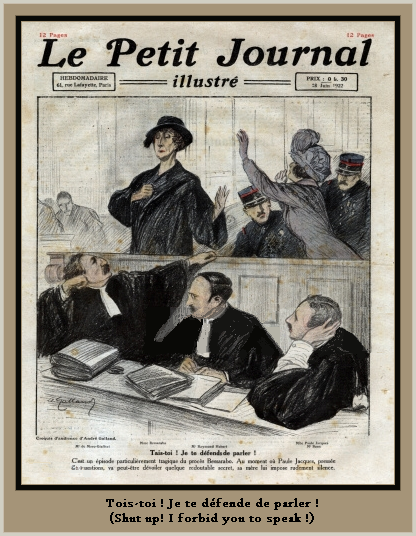
Marie-Louise Victorine Bessarabo (Hera Mirtel), Double Black Widow – France, 1920


Marie-Louise Victorine Bessarabo was a novelist who was known by her pen name, Hera Mirtel (or, Hera Myrtel, in other English language sources).

***

EXCERPT (Article 1 of 2): Héra Mrytel’s early adventures involving dead men, before the 1914 “suicide” of husband Paul Jacques, a silk merchant she had Mexico:

The corners of Héra Mrytel’s mind, in fact, had been darkening progressively ever since her youth, and hidden in the murk was a past littered with dead men. … Notoriety, not business, attended Marie-Louise’s life in Mexico.The dark-complected woman attracted several wealthy young Mexican businessmen. One, it was reported, killed himself over her rejection of her affections. On another occasion, the woman was found by federales in a remote hacienda with a dead man at her feet, a rich merchant with a bullet through his heart. Bandits, the woman claimed through hysterical sobbing, had arrived and killed her lover. The investigating officers were most sympathetic and admitted that, yes, bandits had been causing a lot of trouble in their country for decades; she received an apology and was escorted home.

[Jay Robert Nash, Look For the Woman: A Narrative Encyclopedia of Female Poisoners, Kidnappers, Thieves Extortionists, Terrorists, Swindlers and Spies from Elizabethan Times to the Present, 1981, Evans, pp. 304-305]

***
FULL TEXT (Article 2 of 2): Paris, June 21 – Mme. Marie Bessarabo, poetess and playwright, was found guilty today of the premeditated murder of her husband, Georges, whose body was found concealed in a trunk at Nancy, two years ago. The court found there were extenuating circumstances.

Her daughter by her first husband who also was on trial, was found not guilty.

Mme. Bessarabo was sentenced to 20 years at hard labor.

The principal motive of the murder, it developed at the trial, was the effort of Mme. Bessarabo to obtain a commission of 600,000 francs clue to the husband for oil concessions in Mexico, where they lived prior to 1914.

The first husband of Mme. Bessarabo, Paul Jacques, to whom she was married in Mexico, committed suicide in Paris under strange circumstances in 1914.

~ Girl Accuses Mother ~

Just before the case was given to the jury today, the daughter, who was accused with her mother of killing M. Bessarabo, broke her long silence, accusing her mother of committing the deed two years ago in their Paris apartment. She said the body was packed in a trunk and checked to Nancy.

M. Moro-Giafferi, attorney for the defense, who, had urged his daughter to”tell the truth,” then turned to her saying; “Confess, or I leave the courtroom.”

The daughter, Pauline, told the court that she wanted to call the police, but the mother persuaded her to dag out Bessarabo’s own trunk, in which the two women – the mother with her light arm useless from disease – jammed the body. Then they carried it downstairs, took it from one station to another and finally shipped it to Nancy.

~Mother Livid With Anger. ~

Both mother and daughter, after their arrest in 1920, made a series of confessions, but later repudiated them. Early in the trial Pauline said there was a secret, but her mother would not let her tell it. Today’s last hour’s story confirmed the first story which the women told.

Madame Bessarabo, who is a novelist, is known as Hera Mirtel, mantained the coolest self-possession throughout the trial, but when she was accused in open court by her daughter she rose and, livid with anger, began a confused statement, attempting to show that the body in the trunk was not that of her husband. Finally her story became so wandering that M. Moro-Giafferi had the court adjourned to continue efforts to secure a confession.

[“Madame Bessarabo, Guilty Of Murder, Gets 20-Year Term - Mercy Shown French Poetess Who Slew Husband - Daughter Is Acquitted.” Brooklyn Daily Eagle (N.Y.), Jun. 21, 1922, p. 1]

***

***

***

***

***
 

For links to other cases of woman who murdered 2 or more husbands (or paramours), see Black Widow Serial Killers.

***
[1005-1/13/21]
***

Saturday, September 12, 2015

Florence “Flossie” Hartman, Scheming Double Black Widow – 1938, Pennsylvania


FULL TEXT (Article 1 of 4): Cleveland, Jan. 19. – Mrs. Flossie Hartman, 32, found her estranged husband five times killing him, said Detective Anthony Kosicki.

“Please get me out of here,” Kosicki quoted her as saying from the jail hospital ward where she held today, pending filing of charges in the slating of the husband, Joseph, 32.

“Will they kill me for this?”

Police said Mrs. Hartman told them she arrived from Dunkard, Pa., only a few hours before the killing, which occurred in an automobile parked across the street from Hartman’s residence.

“I don’t know how she missed the baby,” said Miss Mary King, 34, who was sitting in the car also occupied by another man, Neil McKay. Miss King said she once had “gone steady” with Hartman in Pennsylvania.

Mrs. Hartman, who said the couple’s two other children, Roy, 9, and Joseph, 3, are in a Waynesburg, Pa., orphanage, told police that she had come her to effect a reconciliation with her husband, from whom she had been separated six months.

[“Woman Faces Murder Charge – Held In Cleveland After Police Report She Shot Husband, Holding 11-Month-Old Son,” The Evening Independent (Massillon, Ohio), Jan. 19, 1937, 1]

***

***

FULL TEXT (Article 2 of 4): Cleveland, March 20 – A 32-year-old mother of three children planned to leave this afternoon for her home in Waynesburg, Pa., freed of the charge she murdered her husband.

The woman, Mrs. Florence Hartman was accused of killing her estranged husband, Joseph, here last Jan. 10, by firing four shots into his head as he sat in an auto with a 34-year-old divorcee.

The jury, which returned its verdict yesterday, was criticized by Trial Judge Samuel H. Silbert.

Witnesses testified Mrs. Hartman was holding her year-old son in her arms when she shot her husband. [This account is contradicted in later articles on the case.]

Sympathy in the court room yesterday appeared to be entirely with the defendant, a frail woman. During testimony spectators to the room wept and tears were in the eyes of the jury.

Members of the jury, the foreman said, balloted only on a manslaughter verdict, although Mrs. Hartman was charged with first-degree murder.

Judge Silbert, in discussing the case said: “I believe a conviction should have should have been considered. This is a time when a jury is not a reasoning machine but acted as a human institution. The defendant certainly had been mistreated. She twice collapsed on the stand, although this was not done with the intention of influencing the jury – but it did.”

Mrs. Hartman testified her husband beat her frequently and “ran around” with other women. She said he left her in Waynesburg last September, telling her he was going to get a divorce.

She said she had to beg money to come to Cleveland where she intended to attempt a reconciliation.

When the verdict was returned, Mrs. Hartman kissed her attorney. Donald W. Hornbeck. Sympathetic court room spectators gave her $100 worth of clothing to return to her home.

“I am going to forget all about what happened. There’ll be no more marriage for me. I’ve learned my lesson. Getting freed was a pleasant surprise,” Mrs. Hartman said.

[“Woman Killer Freed By Jury – Cleveland Judge Criticizes Verdict for Waynesburg, Pa., Mother,” The Pittsburgh (Pa.), Mar. 20, 1937, p. 3]

***

FULL TEXT (Article 3 of 3): Waynesburg, Pa., Sept. 17 – For the second time in less than two years, the life of Mrs. Florence Hartman, 33, mother of three children, will be in the hands of a jury here this week.

A Cleveland panel freed Mrs. Hartman of the charge of murdering her husband Jan. 10, 1937.

A Greene County jury, probably beginning Tuesday, will decide the guilt of Mrs. Hartman on the charge of slaying her sweetheart, John Andrenok, 22, in her one-room Taylortown home last June 19.

Mrs. Hartman previously was accused of firing four shots into the head of her husband, Joseph, while he sat in an auto with a 34-year-old divorcee in a Cleveland park.

The Cleveland jury that freed Mrs. Hartman on March 19, 1937, was criticized by the trial judge, Samuel H. Silbert, for permitting the woman’s emotional outbursts at the trial to influence their verdict.

The trial in Andrenok’s death originally was scheduled to begin tomorrow, but was postponed a day because of the illness of Mrs. Hartman’s attorney, W. Robert Thompson.

Dist. Atty. Frank Throckmorton said today he would ask for a first-degree murder verdict. The prosecutor said hee would try to prove that Mrs. Hartman purchased the rifle that caused Andrenok’s death in Morgantown, W. Va., two weeks prior to the shooting.

When first questioned by police, Mrs. Hartman was reported saying that she and Andrenok had gone to sleep on the floor at the foot of the bed where her three children were sleeping. She said, according to police, that she was awakened by the rifle shot and found Andrenok lying wounded on the floor.

Later was said to have changed her story, claiming that the gun had accidentally discharged while she and Andrenok were scuffling for its possession.

Mrs. Hartman, frail and timid in appearance, has been in jail since her arrest. Her three children have been wards at the Greene County Home.

The trial judge will be Challen W. Waychoff.

[“Taylortown Woman Again Faces Trial for Slaying – Freed in Death of Husbands, She Faces Charge of Killing Her Sweetheart,” The Pittsburgh Press (Pa.), Sep. 18, 1938, Society Section, p. 12]

***

FULL TEXT (Article 4 of 4): EXASPERATED and amazed, Judge Samuel H. Gilbert heard the jury foreman pronounce the “Not Guilty” verdict. White with anger he pounded the bench with his fist as he charged:

“In view of the direct nature of the evidence it is obvious that emotions, not facts, governed your deliberations!”

Florence Hartman, the exonerated defendant, hardly heard what the judge said; she had been promised a permanent by a publicity-conscious beauty parlor operator if she won her freedom on the charge of killing her husband, and so on that afternoon on March 19, 1937, she walked out of the Cleveland, Ohio, Criminal Court with a saucy flirt of the hips and a crooked smile on her pretty face. . .

Redheaded Florence Marshall had married Joseph Hartman in 1928 at Washington, Pennsylvania, and had borne him four children, the last yet an infant, Hartman proved to be a good provider even if his jobs did take him away from home for months at a time when mechanic’s jobs were scarce in his own state. But his wife, an incorrigible flirt and fiery-tempered, had no appreciation for the efforts of her plodding, conscientious mate; her viperish tongue and ill-concealed amorous associations with men drove Hartman away from home on at least three different occasions.

The last time, alter a particularly bitter quarrel in January, 1937, the harried husband left for Cleveland and Florence finally realized that she had alienated his love and patience. She placed three of her children in an institution and with her baby in her arms followed Hartman to Ohio.

Arriving at the boarding house where her husband was stopping Florence found him seated in a car with a young lady named Mary King; the couple were discussing the sale of Hartman’s automobile to Miss King. Florence, her infant in the crook of her arm, greeted the pair cordially and then, smiling, placed the baby in her husband’s lap.

She then asked for permission to climb in the back seat; this her husband sullenly granted. As soon as she was seated she began pleading: “Joe, won’t you take me back, please.”

“No!” her husband answered. “I took you back three times, it’s useless to try again. I’m going to divorce you and get custody of the children. That’s the only chance we will ever have for peace and happiness.”

Then he turned his attention to the baby and the prospective purchaser of his car. The wife didn’t argue. Matter-of-factly she unzippered her handbag and withdrew an ugly .38 calibre automatic; slowly she raised it to the back of her husband’s head and pulled the trigger. The explosion tore a scream from the King girl’s throat – she scrambled out of the car and Mrs. Hartman deliberately fired three more shots into the sagging head of the man she had sworn to love, honor and obey.

This was the killing which the jury judged no crime – a verdict that brought denunciation from the bench, and a few hours later permitted the elaborately coiffured widow to turn her pretty red head in the direction where she got her greatest satisfaction in the direction of the gullible male.

On June 19, 1938, Sheriff Henry Flowers, of Greene County, Pennsylvania, heard about the shooting of 21-year-old John Andrenock shortly after the youth succumbed at the Memorial Hospital at Waynesburg. Andrenock, Sheriff Flowers was told, had committed suicide at the bungalow of Mrs. Florence Hartman who had returned from Ohio in April, 1937.

Dr. Robert Gans, who phoned the sheriff, stated that he had been called by one of Mrs. Hartman’s neighbors at 3 a. m. that morning, and when he reached the modest home he found Mrs. Hartman sitting on the floor, with the patient’s head in her lap, sobbing, “Why did you do it, Johnnie dear? Oh, why did you do it?” The youth was in a critical condition so the doctor got him to the hospital where he worked over him without success. Mrs. Hartman had accompanied the wounded boy and was with him when he died there some three hours later.

Sheriff Flowers first drove to the bungalow, which was deserted; there he found a blood-stained mattress and a reddened pillow in the middle of the living room floor, a brand new .22 rifle lying significantly alongside. The sheriff picked up the rifle gingerly it was a most uncertain and awkward weapon for suicide. After he stowed the rifle in his car he went through the little house carefully but could find nothing that would warrant the supposition of foul play.

He drove to Waynesburg only to learn there that the woman had left. However, a hint as to her whereabouts had been indicated when she confided to a nurse that her hair looked a mess.

Indeed, Flowers found her in a beauty shop and escorted her to his office for formal investigation and questioning.

The widow showed great distress over Johnnie’s death. She and Johnnie, who was a miner, were to be married in the Fall. Why he should take his life that way, she said, might only be explained by his financial circumstances which would not. permit their immediate marriage.

They had been keeping company for almost a year, and, in spite of scandal-mongers, the gap of ten years in their ages made no difference in their full determination to wed.

Her lover, she continued, called at her home Sunday night and seemed depressed; so when he informed her he was going for a short walk before retiring she made no protest; and while he was gone she made a bed for him on the floor there it would be coolest.

“I went to bed and fell asleep right away so I didn’t hear him come back. How long I slept I don’t know but I was awakened by a shot that frightened me terribly. I managed to get out of bod and into the living room. When I saw the gun I realized what had happened so I dashed to my nearest neighbor and asked him to call a doctor . . . The rifle? I have no idea where it came from. Maybe poor Johnnie borrowed it from somebody while he was out walking.”

The sheriff watched the tears welling in his visitor’s great blue eyes. Then for the first time he recalled that this appealing, pretty woman before him had once calmly killed a man. Immune to her blandishments he decided to lock her up as a material witness until he was satisfied beyond the shadow of a doubt that young John Andrenock had died by his own hand.

Flowers had been unable to find a suicide note at the Hartman bungalow, but there was a possibility that the young miner and recovered the fatal slug. In probing for its course they discovered that it ran straight in, indicating that the gun had been held at a perfect right angle with the left side of the head.

He found no suicide note, but a pants pocket contained something else that puzzled the officer. The pocket held four .22 long rifle shells and, inexplicably, one .33 calibre pistol shell.

If the widow’s story were true, the rifle shells could be accounted for. But why the pistol shell? Did the dead youth own a pistol? If he did why would ho use a small calibre, hard to handle rifle to end his life when a revolver or automatic would have been so much more convenient and certain? Had the .22s been planted?

To account for the extra shell Flowers drove to the little town of Moffitt-Sterling where young Andrenock had lived with his parents. From this grief-stricken couple the sheriff learned that their boy owned .38 which they showed him and permitted the officer to take with him. They told the officer they knew John had been visiting the. widow but they were certain that marriage had been furthest from his intentions.

While all this heightened the sheriff’s suspicions it did not constitute incriminating evidence on which he could logically or legally base a charge against Mrs. Hartman.

Flowers knew he would have to work fast now because it would be a simple matter for an able attorney to secure his prisoner’s release. To establish the ownership of the death weapon seemed to be the next logical step.

Flowers examined the .22 cartridges and recognized them as a type sold only in the Montgomery Ward stores. This narrowed the search considerably because there was only one of these stores in the district, just across the state line in Morganstown, West Virginia.

The sheriff made the trip immediately and questioned John Ashburn, the clerk who handled the sporting goods. Ashburn recalled selling three model 15 Springfield rifles the previous week, one of which he thought was to a woman; but unfortunately he was not required to take names when selling either ammunition or weapons. The clerk readily agreed to make the trip to Waynesburg to see if he could identify Mrs. Hartman as the woman purchaser.

The sheriff took Ashburn to the widow’s cell in the County Jail and was disappointed when the clerk looked in at the prisoner through the barred door and began to shake his head in non-recognition.

Just at that very moment, however, Florence Hartman rose from her iron bedstead and stepped to the door with a gay: “Hello, there! You’re the boy I bought the rifle from last Friday. I knew you’d remember me.”

Sheriff Flowers was dumfounded. Evidently the woman had not seen Ashburn’s head shaking, and in an attempt to outsmart the officer had stupidly trapped herself.

“I thought you said Andrenock borrowed the rifle!” snapped the officer.

“I was too shaken to think straight, sheriff,” she replied gesturing pathetically. “I hope you won’t hold me to all I said when I was so broken up over poor Johnnie.”

The officer’s steely grey eyes stared right through her histrionics as he growled: “I am and I’m placing you under arrest for the murder of your young lover, John Andrenock!”

“But why, sheriff? Why would I kill the man I loved?” she cried. “Why?” repeated the officer sourly. “Because he wouldn’t marry you!”

Later that day Flowers watched while two physicians performed the autopsy on the young miner and recovered the fatal slug. In probing for its course they discovered that it ran straight in, indicating that the gun had been held at a perfect right angle with the left side of the head.

But this was a most improbable position for a right-handed man which the victim was, according to his friends. Further, the flesh showed no powder burns which most certainly would have been there if the muzzle had been held close to the head.

Though all this was still highly, circumstantial, Flowers took his evidence to District Attorney Frank Throckmorton who considered it strong enough to bring the widow to trial on a first degree murder charge.

The trial was scheduled for September 28th, before County Judge Challen W. Waychoff. J. Ernest Isherwood was retained as special prosecutor by the United Mine Workers Union to which the dead youth belonged. On the other hand Mrs. Hartman was defended by two famous and brilliant attorneys, W. Robert Thompson and former Judge A. H. Sayers.

The prosecution had worked diligently up to the time of trial roundup forty-four witnesses to testify for the Commonwealth that Johnnie had stated publicly and privately that the widow was trying to rope him into marriage and that he was doing his utmost to get shut of her. They had no inkling of the defense strategy the woman would offer, because after she inadvertently admitted buying the weapon she would say absolutely nothing more to the police.

But early in the trial the defense showed its hand. Chief Defense Counsel Thompson stated that he would show the jury, without shadow of a doubt that young John Andrenock had been, killed by a bullet “fired accidentally find during a struggle.”

When the widow entered the courtroom she appeared demure in a simple green frock that accentuated the beauty of her hair, and her large melting eyes played up to the “twelve good men and true” as only a woman who had known many men could artfully contrive.

But when District Attorney Throckmorton informed the jury that he would demand the death penalty, the coy defendant was so visibly shocked into realizing her dangerous position that she completely forgot to act.

For two days she sat in sheer terror while the Jury was being selected. On the third day she heard medical testimony to the effect that the weapon could not have been fired by the victim himself and had most likely been fired from some distance. The evidence was graphic, with photographs and diagrams at which Mrs. Hartman stared nervously and with visibly increasing fear and terror.

When the widow left the courtroom for noon recess she gave vent to tears and for the first time appeared on the verge of a breakdown. Everyone expected a dramatic development that afternoon, but none was quite prepared for what actually occurred.

[Terry McShane, “The Strange Case of the Self-Made Widow,” The Gaffney Ledger (S.C.), Dec. 21, 1943, p. 7

***

***
 

For links to other cases of woman who murdered 2 or more husbands (or paramours), see Black Widow Serial Killers.
 
***
[745-1/3/21]
***

Bertha Lankford, Double Black Widow Murderess – 1899, Texas


FULL TEXT: Dallas, Tex., Dec. 23. – When Mrs. Bertha Lankford killed Dr. George A. Lankford in their home in Harrisburg he was the third husband of the woman accused of unfaithfulness and the second whose life was forfeited because of the charge.

The first husband, William Howard of Houston, escaped, so far as physical harm was concerned. He was simply divorced. The second husband was William Smith, also of Houston. His wife tried to kill him, but the bullet went wide and only shattered his arm.  But her brother took up the quarrel, and shot Smith dead. Boyce was acquitted on the ground of justifiable homicide.

In her second attempt to murder a husband Mrs. Lankford took no chances.

She says boldly that she had the right, to kill Mr. Lankford because she was satisfied he had deceived her. But she need have no fear of the law, because death will claim her before an executioner could, even if she were found guilty of murder in tho first degree. She is in the last stages of consumption.

She knows neither remorse or regret. She says her own life has been wrecked by the perfidy of men, and that the least she could do was to make an example of men who betray.

There was no young woman in Texas whose career was brighter in promise than hers. She is now little more than thirty and in ten years has been crowded much misery and desperation.

She was the only daughter, of Captain Robert Boyce, known all over Texas, in business, political and military circles. Bertha Boyce was carefully educated. She had a brilliant mind, was pretty had wealth and position. When her father died he left her $100,000. Then her misery began.

Miss Boyce soon afterward married William Howard of Houston. After two children were born to them Mrs. Howard learned that about her husband which made her secure a divorce.

There was no lack of suitors for the rich Texan woman. William Smith won her affections and they were married.

One day she saw him enter the Casino in Houston with two women companions. Mrs. Smith had long been prepared. She reached into her pocket, grasped a revolver, walked into the Casino and stood before her husband and his companions. Without a word she fired three shots at him. Only one took effect. It shattered an arm.

There was no divorce from William Smith, ltobort Boyce said that Smith and his sister could not both live and he shot Smith dead. He was tried for murder and the jury acquitted him.

Mrs. Smith went to live in her beautiful home in Harrisburg.

Dr. George A. Lankford came to Houston twelve years ago from Maryland. He practiced both in Houston anf Harrisburg, and met with much success.

He knew all about her previous matrimonial experiences of the daughter of Robert Boyce. He and she were married.Trouble began almost immediately. There is no denying that Mrs. Lankford is extremely jealous. She mistook the congratulations showered upon him for attentions which a husband should not receive.

It is not likely that the details of the murder of Dr. Lankford will ever be known. Long before Mrs. Lankford will ever be known. Long before Mrs. Lankford had made up her mind to slay him she discovered proofs of his wrong doing.

She has said repeatedly that she does not know the circumstances surrounding the shooting, that her mind is a blank. But she makes no denial of the murder itself.

As nearly can be learned, she went to the library, where her husband was writing, on Thanksgiving evening. A quarrel was ended by Mrs. Lankford shooting her husband three times. The second shot would have proved fatal had not the first already killed.

She was waiting in the library when a deputy sheriff arrived, waiting there with tho husband she had murdered.

“Dr. Lankford violated his vows and obligations of a husband and I killed him,” she said, “There was nothing else for me to do. I am justified in avenging my wrongs. Look for yourself.”

She pointed to two letters lying on the desk where Dr. Lankford had been writing. They were addressed to a woman in Houston.

After the murder Mrs. Lankford collapsed utterly. It was no plain that she can live but a little time that she was released on $3,000 bail. She was taken to the house of friends, where she is waiting for the end.

[“The Strange Case of Mrs. Lankford.” Oakland Tribune (Ca.), Dec. 23, 1899, p. 5]

***

***

***
 

For links to other cases of woman who murdered 2 or more husbands (or paramours), see Black Widow Serial Killers.

***
[407-1/2/21]
***