
NOTE: The veracity of this
case has been questionable due to the fact that no French source had been
discovered. On July 4, 2016 the first French source was found, confirming that
the Marie Ret case is not a fabrication of an English language writer. French articles will be found below.
Marie Ret was arrested on or shortly before October 27, 1897, and later, with the rest of her gang, charged with more than a dozen murders and robberies. There were certainly additional murders: “The members of the gang now talk freely, in fact, boastfully, about their deeds. Over fifty victims have been found, and it is the opinion of the police that many more are lying in the backwaters of the Seine, which are being carefully dragged.”
Marie Ret was credited with “several” murders committed by her own hand. Her methods were drowning and battery with a hammer (“Quand les gens attaqués opposaient une trop vive résistance, elle les frappait sur la tête avec un marteau qu’on a retrouvé chez elle tout souillé de sang.”); (“jeter à l'eau ses victimes”).
*** Marie Ret was arrested on or shortly before October 27, 1897, and later, with the rest of her gang, charged with more than a dozen murders and robberies. There were certainly additional murders: “The members of the gang now talk freely, in fact, boastfully, about their deeds. Over fifty victims have been found, and it is the opinion of the police that many more are lying in the backwaters of the Seine, which are being carefully dragged.”
Marie Ret was credited with “several” murders committed by her own hand. Her methods were drowning and battery with a hammer (“Quand les gens attaqués opposaient une trop vive résistance, elle les frappait sur la tête avec un marteau qu’on a retrouvé chez elle tout souillé de sang.”); (“jeter à l'eau ses victimes”).
FULL TEXT (Article 1 of 5):
~
STRANGLERS OF PARIS – FOUND IN REAL LIFE. – The Daring Leader of a Band
of Parisian Garroters and Robbers, at Last in the Hands of Justice –
The Story of Her Startling Career – A Life History as Gruesome and
Bloody as Any Ever Traced by Gaboriau Drawing to Its Close – The
Heroine’s Strange Personality and Her Thrilling Capture. ~
***
After
months of patient and novel strategy, exhausting all the resources of
the cleverest detectives in the world, Marie Ret, “Queen of the
Stranglers,” has at last fallen into the toils of the Paris police.
All Paris breathes easier. All France feels a sense of relief, for with this vicious woman abroad since she began her cruel career of crime no one has felt at ease
Marie
Ret is known to have played an important part in at least a dozen
horrible murders by strangulation, and several murders are laid to her
individual charge. There is little or nothing in modern history of
womankind with which to compare the sanguinary career of this
“Queen of the Stranglers.” Cunning, unnatural and uncanny as she has
been in her mad, murderous life, the one touch of nature that has moved
her in years has been her undoing. Her capture was effected through her
reckless desire to meet again the man she loved.
Marie’s
life history excels in gruesome criminality of the lurid imagination of
Sue or Gaboriau. The stamp of the murderess is on her features. Though
old in crime, she is but twenty-eight years of age. She is 5 feet 8
inches tall, and has a finely proportioned figure. She stands erect, and
defiance is constantly depicted on her hardened face. She is lithe and
active, and her strength is phenomenal for one of her sex. She is
without fear, and a fiend incarnate when roused.
Her
hair is jet black, and her sunken gray eyes are set unusually close
together. Her features give evidence that she was once a handsome woman,
but her expression now Is more that of a beast of prey than any human
being—fierce, lowering and furtive. Her sinister aspect is intensified
by several scars, the mark of, desperate hand-to-hand encounters. One
gash, more ugly than the others, lies deep in her left cheek and rims
across her nose. Her hands are singularly small and soft, indicating
that she has done no menial work.
The
parentage of Marie is unknown. She seems to have been a waif of the
streets, left to mold her own destiny. She chose the worst career
imaginable – that of a persistent destroyer of human life. She fell
among the wickedest people of the wickedest city, and from her earliest
girlhood she has been marked as the companion, instigator, accomplice
and mistress of some of the worst Parisian criminals. She made the dens
of Belleville and Montmartre her rendezvous. She was loved, in their
rough way, by the vicious inhabitants of those districts. They loved her
for her daring, and as she grew to womanhood, her influence among the
most dangerous organized gangs of the steadily increased.
The
exigencies of her career of crime she has applied the power of
initiative resource and personal daring which compelled the admiration
and docile obedience of successive bands of robbers and systematic
murderers. Having played their best parts, as subjects of their “girl
queen” they have nearly all gone to the guillotine or are paying the
penalty for their crimes in New Caledonia.
But
Marie time and time again eluded the myrmidons of the law, for her
instruments, her desperate accomplices, false to all else, were true to
the last to her, and could not be induced to give the police information
concerning her. Three times this Amazon among women, who thoroughly
deserves the soubriquet by which she has long been known, “the Terror of
the Fortifications,” has been in the grasp of the police, but all the
arts of the examining magistrate failed to trap her into convicting
herself.
Two
years ago Paris was aghast at the perpetration of a series of eleven
terrible murders. The method of each was strangulation, and the object
in each case was apparently nothing more than murder. The scenes of all
the crimes were the vicinities of the principal gates leading out of
Paris through the fortifications. The victims were of the lower walks of
life or of the middle classes, workmen or small tradesmen. In each
instance they were attacked as they were returning afoot to their homes
in the city in the dark winter evenings. In no case was the booty
obtained more than 100 francs. Everything of value was taken from the
victims’ bodies, even their boots and clothes.
It
was known that a strong-minded young woman of the lower class of
society was the chief actor in these tragedies, and she soon came to be
known as “the Terror of the Fortifications.” The Paris fortifications
are surrounded by a broad moat full of slimy green water. It was in the
water of this moat that the bodies were found, and it was found after
examination that each presented similar injuries. The gruesome work was
evidently that of garroters, trained by some master hand. That hand is
now known to have been Marie Ret’s.
The
modus operandi was for Marie to decoy the intended victim into the
thick bushes surrounding the fortifications. Once inside he was seized
from behind by two accomplices and garroted. To make assurance doubly
sure the woman leader herself plunged a dagger into the victim’s heart.
After the body had been stripped and the clothing rifled the corpse was
cast into the stagnant water of the moat.
Since
midsummer the police have been gradually gathering in members of the
murderous band, until nearly twenty have been taken. But the capture of
which they are proudest is that of the woman leader, who was put under
lock and key. On Thursday, Nov. 4, more than a dozen murders and many
robberies are charged against them. In the lodgings of one member of the
band nearly fifty stolen watches and twenty pairs of boots were
found.
The
male members of the gang when captured from time to time were induced
to furnish more or less
https://www.blogger.com/blogger.g?blogID=1496069017254326809#editor/target=post;postID=5285540473191937712;onPublishedMenu=template;onClosedMenu=template;postNum=5;src=linkinformation
about their male accomplices, but
were one and all as mute as oysters when questioned by the Juge
d’Instruction concerning their chief. Most of them trembled and turned
pale at the mention of her name. Marie’s power over her associates was
not that of a handsome woman over the average man, but was the power of a
strong will over weaker ones. Even after six men known to belong to
Marie Ret’s band had been arrested and convicted on charges of murder
two more horrible murders were committed to precisely the same manner as
the others, and it is believed that they were committed by Marie
herself. Detectives then swarmed about the fortifications, and the woman
murderer was driven into deeper retreat than ever.
Despairing
of all other means of detecting her the police decided to put Jacques
Gozin, a dangerous character with whom she was known to have had
intimate relations, under perpetual surveillance. Jacques is a handsome
young man, and is reported to be a shop thief. Her infatuation for him
was safely relied on to lead Marie eventually to her capture. For five
months the shadowing of Gozin proved ineffectual. As the close watch
kept upon him made it impossible for him to gain his livelihood by the
usual means he was, reduced to an almost starving condition.
Eventually, on Nov. 4 [sic; incorrect date], Marie
risked everything to see her starving lover. She went to visit him in a
low cabaret in the Avenue des Ternes. There several detectives and two
gendarmes swooped down upon her. A desperate struggle ensued, and the
woman proved almost a match for them even against such odds. She fought
like an enraged tigress at bay, and several of the officers bear the
marks of a sharp knife which she managed to use freely before she was
overpowered.
Like
most murderers Marie Ret was always a woman of very few words, and
since her capture she has not betrayed herself. Since her detention she
has lived in constant terror of her accomplices giving information about
her to the police. She has always been regarded by her associates as
being a mascot, but now that she has fallen from power into the hands of
the police, like many of her subjects before her, the officials believe
that they will halve no difficulty in getting evidence against her from
her confederates. The criminal hordes of Belleville and Montmartre are
as much relieved by her capture as are the law-abiding citizens of
Paris.
Several
murders having been laid to her individual charge, this police expect
to be able to send her to the guillotine soon after the next assizes.
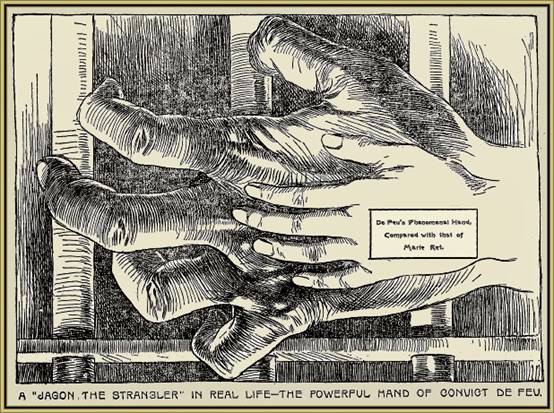
The
capture of Marie Ret will lead at last to the death of Gustave De Feu,
known in Paris as the “Murderer made by God.” For three years the
guillotine has been hungry for him, but a happy phrase and the sentiment of the French people have, up to this time saved him.
In
all the annals of Parisian crime no murderer has excited the same
interest as De Feu. His case from every standpoint is unique, and that
has been his salvation. He is the first murderer sentenced to the
guillotine in France who has not been executed within a reasonable time
after sentence had been passed.
Three
years have elapsed since De Feu was ordered to the guillotine, but so
tremendous was the demand, made by the French public in his behalf that
ho was transported for life to the French penal settlement at New
Caledonia.
De
Feu was a brick mason. He was accounted a good workman. He held one job
continuously for fourteen years. He lost it, not through any fault of
his own, but as a result of a general strike in the trade.
Up
to that time and for months after no one paid particular attention to
him. His life had been a regular routine. But the strike altered that.
He
had to get work. He, applied at many places and at many places got
employment. But he was forced out of every job by a bodily deformity. He
had enormous hands – hands that wore out of all proportion to his body;
hands that would have looked out of place on the biggest of giants.
They
were monstrous hands – three times as large as a human hand should be.
They were so large and long and ungainly that all his fellow-workmen
laughed at them and ridiculed him out of his position. They were his
curse, those hands. But they were strong. Between his fingers and thumbs
he could bend money and iron. He could grind a brick to pieces in the
palm of his hand, or twist a horseshoe into any shape.
But
laughed out of every position De Feu could earn no money, and having no
money he could buy no food. When he begged men and women would say to
him, “A man with hands like you should be able to make a living.” Thus
did his hands place him between two fires.
He
was hungry and he could stand it no longer. One night near the Paris
fortifications he asked a man for money he was refused. With one hand,
De Feu grasped the man by the neck. With the other rifled his pockets.
He ran, but at the point of a revolver two gendarmes arrested him. They
brought him back to the victim to get his account of the affair. The
victim was dead. The one grasp of that monstrous hand had broken his
neck.
De
Feu was tried, convicted and sentenced to the guillotine. The trial was
memorable. De Feu said only one thing. He said: “If I am a murderer,
then I am a murderer made by God. I didn’t mean to kill him. It was my
hand. I didn’t know It was so strong.”
That
was all he said. But that speech caught the French people. They arose
en masse in his defense, and for three years he has cheated the
guillotine.
But
the capture of Marie Ret brings out the true story. De Feu proves to
have been a member of her gang of stranglers and now no doubt he will
suffer the penalty of his crime.
[“Stranglers of Paris – Found in Real Life,” The World (New York, N.Y.), Nov. 14, 1897, p. 33]
***

FULL TEXT (Article 2 of 5): Thirty-two more have been looked up behind the cold, grey walls of Paris. Two hundred and eight are in the shadow of the guillotine, if M. Cochefort, the Chief of Police in this capital of gaiety and crime, is right Eugene Sue’s “The Mysteries of Paris” has been outdone, Marie Ret, of Paris, had a gang of eighteen stranglers which she had gathered around her. More than thirty murders were directly found to have been committed by this organisation of trained assassins, which had for chief a woman, and whose principal black workman was “the murderer made by God” — the man whose hands were built so strong and large that with one simple twist of his awful wrist he could squeeze the life out of a man’s neck as you would squeeze and break a straw. Now, through the capture and incarceration of the murderous clan headed by Pierre Columbin, it has been learned that not only were there others — thirty-two have been arrested in this last great effort — but there were more than a hundred and ninety others. Indeed, it almost teems as if a great clearing house for crime had been established in Pans, whose head-quarters were the dingy lodgings of Columbin, on the Rue de Venice — in the very shadow of Notre Dame, and in a quarter where the police watch as closely as they do in any place on earth — and that under this horrid leadership all the assassins of the earth had gathered here to do their deeds of violence.
The first capture — the capture which has led up to the incarceration of all the gang — was cleverly made about a week ago. Inspector Gobert was the detective who is entitled to the credit of catching the first of the crew which had for months defied the ingenuity of all the police at Paris. Gobert had been among the forty or fifty men assigned to catch the murderers operating in the suburbs. He had do particular reason for doing so, but he fastened his eyes on a man known as Lambinet, an ex-convict of tremendous stature and great strength, who was celebrated as one who was always armed and who earnestly would make an effort to kill the next police officer who should attempt to put him behind the bars. Many and many a eight Gobert searched for him in those pans of Paris which men of his character frequent. At two in the morning, Gobert, who is a very little man without physical strength, but with a determination which might fit a Samson, wandered around to the “Chateau Rouge,” once the palace of the famous Gabrielle d’Estee, but now the resort of the lowest criminals in Paris. It gets its name from the fact that there is nothing about it which is not painted red. But night after night he found Lambinet missing. Next day murders were always reported from the suburbs; A night or two afterwards the suspected man would turn up. Gobert would question him casually, as one who is of the same class might question him. Always he bad some good excuse for his absence, and under the French law Gobert could nod no reason for arresting him. But one night Gobert talked to him for hours, and certain admissions were made which have not been given to the public and which gave the detective sufficient reason for taking the man to prison. When this occurred they were alone in a little cafe in one of the worst quarters of the town, and Gobert was far from a match for his sturdy, enemy. He devised a clever ruse. First of all he called for pen, ink and paper. With these he wrote a note saying that he was Inspector Gobert, that he intended to pick the pocket of the convict Lambinet that would dig cover the theft, and that himself to; be unknown as a convict in the nearby Lambinet police station, would doubtless drag the supposed thief (Gobert) off to the station. This note once written and placed in his coat pocket he did as he had said in it that he would do.

“With the most elaborate care — so elaborate that he knew that Lambinet would discover him— he took from the letter’s pocket whatever there was in it of value. Lambinet saw what was going on at once, instantly seized the little detective in his herculean grasp and dragged him to the nearest police station. No one there knew Gobert, but when they came to search him they found in his pocket the note telling the details of his plan. A moment afterwards the great Lambinet was amazed to find himself thrown on the floor and held a prisoner by half-a-dozen gendarmes.
***
FULL TEXT (Article 2 of 5): Thirty-two more have been looked up behind the cold, grey walls of Paris. Two hundred and eight are in the shadow of the guillotine, if M. Cochefort, the Chief of Police in this capital of gaiety and crime, is right Eugene Sue’s “The Mysteries of Paris” has been outdone, Marie Ret, of Paris, had a gang of eighteen stranglers which she had gathered around her. More than thirty murders were directly found to have been committed by this organisation of trained assassins, which had for chief a woman, and whose principal black workman was “the murderer made by God” — the man whose hands were built so strong and large that with one simple twist of his awful wrist he could squeeze the life out of a man’s neck as you would squeeze and break a straw. Now, through the capture and incarceration of the murderous clan headed by Pierre Columbin, it has been learned that not only were there others — thirty-two have been arrested in this last great effort — but there were more than a hundred and ninety others. Indeed, it almost teems as if a great clearing house for crime had been established in Pans, whose head-quarters were the dingy lodgings of Columbin, on the Rue de Venice — in the very shadow of Notre Dame, and in a quarter where the police watch as closely as they do in any place on earth — and that under this horrid leadership all the assassins of the earth had gathered here to do their deeds of violence.
The
capture of Marie Ret and her crew of desperadoes was accomplished, as in
the capture of most gangs of criminals in which a woman or in which
women play an important part, through jealousy.
The real panic began
in June. Neuilly, Levalloisperril, Courbevoise, and Clichy were driven
nearly wild with excitement. Nearly every night some person was reported
from one or the other of these towns as missing. Such an epidemic of
disappearances never had occurred before in the vicinity of Paris. At
the same time the number of corpses found in the Seine began to rapidly
increase. Even the hardened Frenchmen who have charge of the awful Paris
morgue, where the bodies of the dead are exposed to the public in a
great show window, shuddered as day after day and day after day, drowned
men and women were brought in labelled by the police, “Found in the
Seine.” Each one had on it, somewhere, the marks of violence. More
startling than these general signs of murder was the fact that every
body found during this period of the Seine’s horrid fertility was minus
its shoes and stockings. It has since been discovered that it was a
superstition of all the members of the gang headed by the dreadful
Columbin to take off and gruesomely preserve the shoes and stockings of
the people they had killed.
In something less than three months not
less than fifty-four bodies of murdered persons were taken out of the
Seine within the very boundaries of Paris. Up to that time, and, indeed,
up to this time, no proper arrangements were made for dragging the
river outside the fortifications. It is now believed that in the
“back-water” of the Seine — these curious eddies which swirl and swing
in the curves and little bays of this strange French river before and
after the regular confining walls which hold it to a straight course
within the limits of Paris— it is now believed that in these
“back-waters” not. less than a honored other victims of this frightful
crowd are lying, with staring eyes and rigid flesh — dead.

The first capture — the capture which has led up to the incarceration of all the gang — was cleverly made about a week ago. Inspector Gobert was the detective who is entitled to the credit of catching the first of the crew which had for months defied the ingenuity of all the police at Paris. Gobert had been among the forty or fifty men assigned to catch the murderers operating in the suburbs. He had do particular reason for doing so, but he fastened his eyes on a man known as Lambinet, an ex-convict of tremendous stature and great strength, who was celebrated as one who was always armed and who earnestly would make an effort to kill the next police officer who should attempt to put him behind the bars. Many and many a eight Gobert searched for him in those pans of Paris which men of his character frequent. At two in the morning, Gobert, who is a very little man without physical strength, but with a determination which might fit a Samson, wandered around to the “Chateau Rouge,” once the palace of the famous Gabrielle d’Estee, but now the resort of the lowest criminals in Paris. It gets its name from the fact that there is nothing about it which is not painted red. But night after night he found Lambinet missing. Next day murders were always reported from the suburbs; A night or two afterwards the suspected man would turn up. Gobert would question him casually, as one who is of the same class might question him. Always he bad some good excuse for his absence, and under the French law Gobert could nod no reason for arresting him. But one night Gobert talked to him for hours, and certain admissions were made which have not been given to the public and which gave the detective sufficient reason for taking the man to prison. When this occurred they were alone in a little cafe in one of the worst quarters of the town, and Gobert was far from a match for his sturdy, enemy. He devised a clever ruse. First of all he called for pen, ink and paper. With these he wrote a note saying that he was Inspector Gobert, that he intended to pick the pocket of the convict Lambinet that would dig cover the theft, and that himself to; be unknown as a convict in the nearby Lambinet police station, would doubtless drag the supposed thief (Gobert) off to the station. This note once written and placed in his coat pocket he did as he had said in it that he would do.
“With the most elaborate care — so elaborate that he knew that Lambinet would discover him— he took from the letter’s pocket whatever there was in it of value. Lambinet saw what was going on at once, instantly seized the little detective in his herculean grasp and dragged him to the nearest police station. No one there knew Gobert, but when they came to search him they found in his pocket the note telling the details of his plan. A moment afterwards the great Lambinet was amazed to find himself thrown on the floor and held a prisoner by half-a-dozen gendarmes.
The next
day, probably through information furnished by Lambinet, all the police
of Paris were concentrated in the suburbs. The true details of how M.
Cochefort arranged the tremendous drag-net which he spread all around
Paris that night will probably never be known, but it is certain that
the net was big and that the net was strong, and, moreover, that when
the morning dawned the net held in its meshes the very fish for which it
had been spread. This showed an intimate knowledge of the workings of
the gang. There is very little doubt now that their long immunity from
capture had been due to the cleverly planned system of espionage of the
police. M. Cochefort says
that the gang had had trained pickets whose business it was to notify
their fellows when the police decided to descend on Neuilly, and that
that night, the gang was certain to operate in Courbevois.
After
Lambinet, the next member of the gang to be taken to the Central Depot
of the police was one named Gustavo Constant, and known as “The Terror.”
He almost escaped justice by a most extraordinary trick. From the fact
that the police who caught him and the police who examined him at the
depot – where every prisoner captured during the night in the Parisian
district is taken the next morning – never suspected that his capture
was moiré than a chance happening or dreamed that he was the member of
any gang, it seems probable that the drag-net plan was known only to
Couchefort. Constant was caught in Clichy, almost in the act of
assassination. He doubtless regarded his capture as a matter of chance,
quite as did his captors. The story of how he attempted to escape the
consequences of his deeds is told now from his own confession. It is a
curious fact that very nearly every one of the men who have been
arrested have since their incarceration – and only a few days have
passed – expressed an entire willingness to reveal not only the
wrongdoings of their fellows, but to tell of their own sins. M.
Bertillon, who system of measurements for the identification of
criminals has, I understand, recently been adopted by the police of New
York City, and who is in charge of the criminological department of the
Paris Depot, says that this anxiety to confess is one of the strangest
freaks he has ever known in his study of wrongdoers.
Each prisoner,
when taken into the depot, is questioned as to his name, &c., as
prisoners are questioned in other police headquarters. Then he is taken
up a stone stairway, winding in a tower so sharply that the gendarme who
precedes him and the gendarme who follows him are hidden by the curves
of the way. After he reaches the upper floor, where he waits for
measurement and definite recording, he is placed in a little box, so
arranged that no prisoner can see any other prisoner. A guard passes
before each one and casually examines him about once in every five
minutes. During the few minutes occupied in going up the winding
stairway and during the few moments while he was not under the watchful
eye of the guard in the box, Constant almost choking himself to death,
tearing his throat and chest horribly with his own fingers and otherwise
awfully mutilating himself with no other instrument than his own
hands.
When he was taken to plead he showed these wounds and claimed
self-defence. In ordinary circumstances he would have escaped. It was
only the fact that Cochefort knew that he was a member of Columbin’s
gang that led to further investigation. Then the fingers of the dead
man, whom Constant claimed had assaulted him, were placed on the marks
of his neck and found not to fit. It was then seen that his own hands,
which are distinguished by several peculiarities, would have made
bruises and wounds exactly like those which his body showed. The dead
man was taken back to him once more for the ordeal of the
“confrontation” — the one relic of barbarism which still stands on the
statute books of France — and Constant broke down and told all about his
shrewd plan for escaping punishment.
The organisation operated
under August Columbin was told off in groups and vedettes, the former
taking up a position at frequented crossroads, while the latter lay in
ambush down the side-roads ready at a signal to approach the victim or
the police. When it came to attacking, the knife, revolver or “American
fist” — an iron-spiked knuckleduster — was employed.
It was in
August last that the number of murdered bodies taken out of the Seine
began to frightfully increase. The thirty- two men safe under lock and
key range from seventeen to thirty years of age, including the
following, whose expressive sobriquets are quite in keeping with the
traditions of a city where organized crime has flourished to an extent
unknown either elsewhere in Europe or in America, Columbin, the captain,
is twenty-five. When arrested he was dressed as a respectable workman,
his favourite character. He is fair, about middle height, and of very
slight, even fragile figure. He has pale blue eyes, close cropped fair
hair, high cheekbones, and peculiarly forbidding expression of
calculating cruelty in his sinister eye. Other members are Pierre
Chretien, called “Little Pierre,” because his diminutive stature and
childlike aspect enabled him, when dressed as a boy, to attract the
sympathy of passers-by pretending to be lost; Adolf Collin, called “The
Rat,” owing to the singular rodentlike formation of his mouth and
protruding teeth; Gustave Constant, called “The Terror,” his part being
to lead the attack on a victim in front by blinding him or her; Eugene
Chanier, called “Garters,” as hew always affected these pedal
adornments; Gabrielle Gauthier, called “Woodenhead;” Jacques Girod,
called “Bird,” as he occasionally earned a living at neighbouring fairs
by imitating birds’ singing; Ferdinand Darbelle, called “The Sardine,”
and Georges Weerth, expressively termed “Hatchetface.” The latter is
only seventeen years of age, but is reputed the most blood-thirsty
member of the entire gang.

Domiciliary visits made after the capture of the desperadoes revealed a big collection of instruments of their ghastly trade, which Cochefort describes as a “veritable museum of crime.” They include a length of telephone wire having a leaden ball fastened to one extremity; a bludgeon weighing nearly six and a half pounds, and an elastic bait for closing over the mouth of the person attacked.
Domiciliary visits made after the capture of the desperadoes revealed a big collection of instruments of their ghastly trade, which Cochefort describes as a “veritable museum of crime.” They include a length of telephone wire having a leaden ball fastened to one extremity; a bludgeon weighing nearly six and a half pounds, and an elastic bait for closing over the mouth of the person attacked.
The most horrible instruments were the knuckledusters,
with projecting spikes four inches long emerging from between the
fingers when the hand of the wearer was shut. These spikes were about
two inches apart. They were plugged into the victim’s eyes while he was
at the same time being assailed from behind. Nothing could be more
ghastly than the whole collection, nothing more callous than the
subsequent disposition of the victim’s body.
This band had only one
woman attached to it. Cochefort said they were wise in this, for
otherwise they could not have escaped detection so long. She was used as
a decoy. A man would be returning quietly home at about midnight from a
suburban party. Suddenly he hears cries for help. He hurries to the
crossway, where he sees a woman running toward him screaming, with her
face bathed in blood. When in the act of listening to her story, he is
felled like an ox from behind. If the blow should fail, and he rushed
forward, he was blinded by a thrust of the long-spiked knuckledusters.
It is needless to say that none of the victims of the desperadoes has
ever lived to tell the tale, nor was anything known of their fate except
that they were missed by their friends, and that in some cases their
bodies were found long afterward.
The members of the gang now talk
freely, in fact, boastfully, about their deeds. Over fifty victims have
been found, and it is the opinion of the police that many more are lying
in the backwaters of the Seine, which are being carefully
dragged.
The flexible wire with the leaden ball at the end is a new
instrument of assassination to the Paris police. It was used cleverly.
The wire is about one hundred feet long. Constant, the man in whose
house, it was found, became exceedingly expert in his aim. Holding the
end of the wire firmly in one hand, he could hit the back of a
pedestrian’s head with the leaden ball at a distance equal to the full
length of the wire. This had advantages. In the first place, he could
kill without tackling and without the noise of a pistol. In the second
place, throwing the ball in semi-darkness, he could pull it back by the
wire, and if anyone saw the victim fall, they would find no evidence of
the connection of the murderer with that of the distant
pedestrian.
The victims were chiefly workmen and small shopkeepers
of the surrounding district. No well-to-do person would trust himself
late at night in the places where the gang operated. Men, however, were
not the only objects of the attack. The class of unfortunate women
suffered heavily, it being the practice for the woman’s “ami de
rencontre” — really a member of the gang — to lead her down the road to
the river, where she would be suddenly garroted, her pockets rifled, her
clothes taken. Whether the robbery was fruitful or not, her body was
cast into the river to save further trouble. Most of the bodies of women
picked up in Seine were entirely nude, although in some cases the only
articles taken from them were boots and stockings.
It was only too
patent that there must be many victims still missing, for since the
discovery of the gang people are turning up every day at the prefecture
with stories of missing friends and relatives who disappeared about the
time the gang was operating.
Not until a huge police net was thrown
for weeks over the entire suburbs did the crimes begin to lessen, and
men were arrested one by one. They are now offering to give evidence
against each other, but the police are anxious to get Columbin, the only
one who has not spoken, to tell what he knows. They believe this band,
large as it is, to be only a part of a huge conspiracy of crime which
cannot be extirpated until the unseen director is safe in gaol. But the
men have so far refused to admit any connection between their gang and
any other. They deny the statement that there is a great controlling
power that organises these bands of murderers which have been so
frequently caught in Paris of late.
[“Black
Mysteries of Paris Cleared At Last – Eugene Sue’s greatest novel more
than revealed by horrid fact,” The World (New York, N.Y.), Jan. 9, 1898,
p. 35]
[“It is need-less to say that none of the victims of the desperadoes” correction of error in original by guessing at missing words (in italics)]
***
 ***
***

***

For similar cases, see: Female Serial Killer Bandits
***
FULL TEXT (Article 3 of 5): — Les étrangleurs du pont de
Neuilly. — Le service de la Sûreté vient de mettra la main sur les receleurs de
la bande des étrangleurs du pont de Neuilly, dont la plupart ont été arrêtés
pendant les mois de juillet et d’août derniers.
Ces receleurs, les deux frères Leroy habitaient une maison
particulière dans le quartier des Ternes, et M. Cochefert a retrouvé dans leur
domicile une partie des bijoux volés aux victimes de la bande des étrangleurs.
Une souricière organisée par les agents aux abords de la
maison habitée par les frères Leroy a permis d’ arrêter une femme, Marie Ret,
dite « La Terreur des foriifs », maîtresse de François, l’on des principaux affiliés de la bande. Dans le
logement occupé par cette femme, on a trouvé plus de trente paires de souliers
en cuir jaune provenant des dépouilles des victimes. L’ami de Marie Ret avait
une préférence particulière pour les souliers de cette couleur, et il attaquait
souvent les passants attardés sous le seul prétexte de s’approprier leurs
chaussures.
[“Les étrangleurs du pont de Neuilly.” Journal Du Loiret
(France), Oct. 29, 1897, p. 3]
***

***
FULL TEXT (Article 4 of 5): La Sûyeté arrêtait au mois de juillet une bande
composée de seize personnes qui avaient pour spécialité de guetter leurs
victimes à une heure avancée de la nuit, à l'entrée du pont de Neuilly. Après
les avoir dévalisées, ils les étranglaient et les jetaient à la Seine.
Ces misérables bandits doivent passer prochainement aux
assises.
Hier, M. Cochefert a réussi à retrouver la trace des frères
Leroy, les receleurs de la bande, et les a arrêtés aux Ternes.
Une souricière établie devant la demeure des frères Leroy a
permis également au chef de la Sûreté de mettre la main sur une fille Marie
Ret, dite la a « Terreur des fortifs ».
Marie Ret vivait-avec François, le chef de la bande. Elle
s’est défendue avec une énergie farouche et a frappé les agents qui
l'arrêtaient à coups de couteau.
C'est une fille de vingt-huit ans, grande, élancée, assez
jolie, une véritable héroïne des Mystères de Paris. Sa spécialité était de
jeter ses victimes à l'eau. Très vigoureuse, elle pouvait « travailler » seule
et a souvent réussi à « expédier son homme ». On a trouvé à son domicile plus
de cinquante montres et, détail curieux, une quantité considérable de souliers
jaunes qu’elle. avait volés à ceux qu'ella dévalisait. Comme M. Cochefert lui
demandait pourquoi elle avait conservé tous ces souliers jaunes.
François, a-t-elle répondu, affectionne ce genre de
chaussure.
La « Terreur des Fortifs » nie énergiquement les crimes
qu'on lui impute.
[“Les Étrangleurs Du Pont De Neuilly” La Gaulois (Paris,
France, Oct. 27, 1897, p. 3]
***


Poem set to music ("monologue") about Marie Ret:
FULL TEXT: Nous avons eu occasion de parler, à plusieurs
reprises, de ces bandits qui, l’été dernier, guettaient les passants dans les
rues de Neuilly, dépouillaient leurs victimes, les étranglaient et jetaient
leurs cadavres, tantôt dans la Seine, tantôt dans les fossés des
fortifications. A grand’peine, quelques arrestations avaient pu être opérées,
mais les individus capturés n’étaient que de simples comparses. Leur chef, une
femme, avait toujours, jusqu’à présent, réussi à échapper aux recherches dont
elle était l’objet. On a fini cependant par la découvrir et l’arrêter à
Levallois-Perret, où elle habitait. Cette femme se nommait Marie Ret, et, dans
le monde des a « escarpes » et des « surineurs », on la surnommait « la Terreur
des Fortifs ».
Elle attaquait elle-même les passants et, tandis qu’un des
hommes de sa bande comprimait le cou de la victime, elle fouillait les poches
du malheureux. Quand les gens attaqués opposaient une trop vive résistance,
elle les frappait sur la tête avec un marteau qu’on a retrouvé chez elle tout
souillé de sang.
C’est M. le juge Lemercier qui est charge de l’instruction
de cette affaire.
[“Les Étrangleurs Du Pont De Neuilly,” Le Figaro (Paris
France), 27 Octobre, 1897, p. 2]
***
Poem set to music ("monologue") about Marie Ret:
Grande, élancé, carne, d'attaque,
Le poing dur et bien attaché;
Ferme et râblé', sous la casaque,
Ell' faisait la chasse au michet,
A coups d'surin ou d' sucre d' pomme,
Et, souvent, la batteus' d'antifs,
Comme un mâle, abattait son homme…
C'était la Terreur des Fortifs…
Translation:
Le poing dur et bien attaché;
Ferme et râblé', sous la casaque,
Ell' faisait la chasse au michet,
A coups d'surin ou d' sucre d' pomme,
Et, souvent, la batteus' d'antifs,
Comme un mâle, abattait son homme…
C'était la Terreur des Fortifs…
Translation:
Tall, slender, mean and fit,
Taut and muscly under her blouse,
She’d go after punters
With a blade or a crowbar;
She’d often bring down her prey,
Just like a man …
She was the terror of the fortifications.
[James Cannon, The Paris Zone: A
Cultural History, 1840-1944, 2015, Ashgate, p. 84]
Marie Ret and the Bruant song are discussed in: Marguerite Steen, Autobiography, Longmans, 1966, p. 97
Marie Ret and the Bruant song are discussed in: Marguerite Steen, Autobiography, Longmans, 1966, p. 97
***

EXCERPT: « Cette femme, nommée Marie Ret, dite "La
Terreur des Fortifs", mettait souvent la main à la besogne. Agée de
vingt-huit ans, grande, élancée, assez jolie, bien qu'elle ait la figure
balafrée de coups de couteau, Marie Ret est une véritable héroïne de roman.
Très vigoureuse, ella souvent "expédié son homme" ; sa spécialité
était de jeter à l'eau ses victimes.
Dans son logement on a trouvé plus de trente paires de souliers
en cuir jaune, provenant des dépouilles de ses victimes. François, son amant,
avait en effet une préférence marquée pour les souliers de cette couleur, et
lui et sa maîtresse attaquaient souvent des passants attardés, uniquement pour
s'approprier leurs chaussures estivales. »
Translation:
This woman named Marie Ret, called "The Terror of the fortifications," often put her hand to work. Aged twenty-eight, tall, slender, pretty enough, although disfigured by a scar from a knife slash, Marie Ret is a veritable heroine of fiction. Very vigorous, often she “dispatched her man,” her specialty was to drown her victims.
Translation:
This woman named Marie Ret, called "The Terror of the fortifications," often put her hand to work. Aged twenty-eight, tall, slender, pretty enough, although disfigured by a scar from a knife slash, Marie Ret is a veritable heroine of fiction. Very vigorous, often she “dispatched her man,” her specialty was to drown her victims.
In her quarters were found over thirty pairs of yellow
leather shoes, taken from of her victims. François, her lover, had a decided
preference for shoes that color, and he and his mistress often attacked belated
passersby, only to appropriate their summer shoes.
[From: Philippe Van den Bossche (ed.), DANS LA RUE; Chansons
& monologues (1889-1895) par Aristide Bruant Transcrit à partir des
documents de la collection Gallica de la Bibliothèque nationale de France,
Février - Août 2007, p. 89]
***
***

***

***

***
***
***
***
***
For similar cases, see: Female Serial Killer Bandits
[2762-1/12/21]
***


You may want to post a warning about the authenticity of this story. Many things about it send up red flags for me, as a work of fiction. First, while I can believe there were gangs of robbers running around Paris and the suburbs, gangs of stranglers, strangling for no reason, and one gang in the hundreds, not so much. Second, in 1879, Adolphe Belot wrote a book called "The Stranglers of Paris," with a very similar plot. They even made a movie out of it 17 years after this article was published. In addition, try as I might, I cannot find the majority of the names mentioned in this article anywhere else, just here.
ReplyDeleteFinally, consider the source. Newspapers, especially The World, were notorious for sensationalism during this time. It would not be uncommon for an article to be completely made up on a slow news day, or simply to sell more papers.
If you have sources aside from this article, I would love to see them. This would be an amazing story, were it non-fiction.
Thank you for this comment. I have indeed failed to find supporting sources. I was vaguely aware of the the novel you mentioned but had not been aware of the plot. I endorse your take on this case and will follow up by reclassifying it as "questionable." There are several other cases that have a "too perfect to be true" narrative quality (notably Vera Renczi) that are perhaps writers' hoaxes. I find that it is most helpful to post these cases "as is" (unless I can disconfirm them with my own resources, as I have done with a number of cases) and await the assistance of others.
DeleteI gave you the benefit of the doubt as you always list many sources, and if you can't, state this in the post. With as many posts as there are, you're bound to miss one or two, lol. Plus, with the age of some of them, it's difficult to find sources in general, so I didn't want to dismiss it out of hand.
ReplyDeleteMarie Ret "Queen of Stranglers": Confirming sources have been located -- and posted.
Delete